
When purchasing linear motion equipment, the first core choice every designer faces is DC vs AC Linear Actuator. Distinguishing the key differences of DC vs AC Linear Actuator in power supply mode, performance parameters, operating characteristics and application scenarios directly determines the matching degree between the actuator and the project. Many users cannot accurately distinguish DC vs AC Linear Actuator, resulting in low equipment operation efficiency, insufficient load capacity or excessive cost waste. In practical automation design, mismatching these two common actuator types is one of the most frequent causes of equipment underperformance, frequent shutdowns, and unnecessary budget loss, especially for designers who lack long-term scenario accumulation.
This guide comprehensively analyzes DC vs AC Linear Actuator from structural principle, performance advantages, applicable scenarios, cost and maintenance, summarizes intuitive differences and practical selection skills, helping users quickly distinguish DC vs AC Linear Actuator and make the most suitable purchasing decision. Whether you are designing civilian smart equipment, medical auxiliary devices, or heavy industrial automation production lines, accurate identification and selection of DC vs AC Linear Actuator can greatly improve project stability, reduce later maintenance pressure, and optimize overall equipment cost performance.
Core Selection Rule: DC vs AC Linear Actuator has clear scenario boundaries. DC linear actuators are for light-load, low-voltage safe scenarios; AC linear actuators are for heavy-load, long-term industrial continuous operation scenarios. Grasping this core boundary is the fastest way to avoid most selection errors between DC vs AC Linear Actuator.
1. Core Structural & Working Principle Differences (DC vs AC Linear Actuator)
The essential difference of DC vs AC Linear Actuator lies in the internal driving motor and power supply mode, which fundamentally determines the performance difference of DC vs AC Linear Actuator. All subsequent performance gaps, safety differences and service life characteristics are derived from this basic structural design, making it essential for every equipment designer to fully understand.
DC Linear Actuator: Adopts DC brush motor as the core power component, powered by 12V/24V low-voltage direct current. The motor runs stably with adjustable speed, simple control circuit, no phase sequence restriction, and can realize forward and reverse rotation by switching positive and negative poles. Most civilian and miniature actuators such as FD10 and FD25 adopt DC driving mode. The internal transmission structure of DC actuators is compact and lightweight, which is convenient for miniaturized equipment installation and hidden assembly. Its startup response is sensitive, with no idle delay, which is very suitable for precision small-stroke motion control.
AC Linear Actuator: Uses AC industrial motor, powered by 220V/380V alternating current. It has strong power output, stable torque and strong overload resistance. The motor structure is durable, suitable for long-term continuous operation, and mostly used in heavy industrial equipment. Different from DC motors, AC industrial motors adopt professional industrial-grade winding and heat dissipation structure, which can bear high-intensity load impact and will not cause rapid temperature rise even after long-hour uninterrupted operation. The overall mechanical rigidity is higher, and the anti-vibration and anti-interference ability in complex industrial environments is far better than conventional DC models.
Understanding the structural principle difference of DC vs AC Linear Actuator is the basis for subsequent performance comparison and scenario matching, and all parameter differences of DC vs AC Linear Actuator are derived from this core distinction. Many users only pay attention to surface parameters such as thrust and stroke but ignore the essential power supply and motor differences, which leads to long-term hidden dangers of equipment instability after selection.
2. Full Parameter Comparison Table: DC vs AC Linear Actuator
This detailed comparison table intuitively displays all key differences of DC vs AC Linear Actuator, covering power, performance, safety, cost and maintenance indicators. By comparing these comprehensive parameters, users can quickly complete preliminary screening of DC vs AC Linear Actuator and eliminate mismatched products in the early stage of project design.
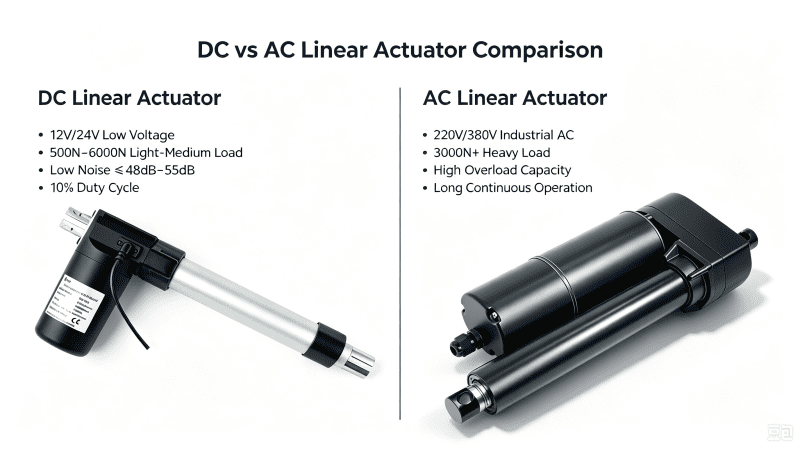
| Comparison Item | DC Linear Actuator | AC Linear Actuator |
| Working Voltage | 12V/24V low voltage DC | 220V/380V industrial AC |
| Output Thrust | Light to medium load (30N~2500N) | Medium to heavy load (3000N+) |
| Operating Noise | Low noise (≤48dB~55dB) | Relatively high noise |
| Safety Level | Ultra-high safety, no electric shock risk | Industrial high voltage, need insulation protection |
| Control Difficulty | Simple wiring, convenient speed regulation | Complex circuit, fixed speed mostly |
| Duty Cycle | 10% standard duty cycle | Long-term continuous operable |
| Cost & Maintenance | Low cost, simple maintenance | High cost, professional maintenance required |
| Typical Application | Smart furniture, medical, mini automation | Heavy industrial machinery, large production lines |
From the overall parameter comparison of DC vs AC Linear Actuator, it is clear that the two types of actuators have their own advantages and limitations. There is no absolute good or bad between DC vs AC Linear Actuator, only suitability for different working conditions. In actual selection, users should not blindly pursue high power or low price, but match the model according to actual equipment operating requirements.
3. Performance Advantage Analysis of DC vs AC Linear Actuator
3.1 Advantages of DC Linear Actuator
In the comparison of DC vs AC Linear Actuator, DC actuators occupy absolute advantages in civilian and light industrial scenarios. Low-voltage DC power supply ensures high safety, allowing frequent human contact without electric shock risk. The operation noise is extremely low, which is very suitable for indoor and noise-sensitive environments. The control mode is flexible, supporting manual switch, wireless remote control and PLC precise control, with low overall cost and almost no daily maintenance. For household and medical equipment that require frequent manual operation and long-term quiet use, DC linear actuators are undoubtedly the most ideal choice in DC vs AC Linear Actuator matching.
Another easily overlooked advantage of DC linear actuators is their flexible installation adaptability. Due to the low-voltage design and compact body structure, DC models can adapt to narrow installation spaces and irregular equipment structures, which cannot be achieved by bulky AC linear actuators. Meanwhile, the startup and stop response of DC linear actuators is more sensitive, with small motion error and high positioning accuracy, which can meet the precision motion requirements of small intelligent equipment.
Compact low noise DC linear actuator and mini waterproof DC linear actuator are classic DC models, covering light-load and waterproof scenarios, and are the most widely used linear actuators in civilian automation equipment. These mature DC actuator series perfectly interpret the core advantages of DC models in low noise, high safety and flexible control in the comparison of DC vs AC Linear Actuator.
3.2 Advantages of AC Linear Actuator
In the comparison of DC vs AC Linear Actuator, AC actuators have irreplaceable advantages in heavy industrial fields. High-voltage AC power supply provides strong and stable output torque, supporting super heavy-load operation. The motor has good heat dissipation performance and long continuous working time, meeting the long-term uninterrupted operation requirements of industrial production lines. The mechanical structure is sturdy and durable, with strong anti-interference ability and stable performance in harsh industrial environments such as high temperature, high dust and strong vibration.
In terms of long-term operation stability, AC linear actuators far exceed DC models. Industrial-grade AC motor-driven heavy-duty linear actuators are designed according to 24-hour continuous operation standards, with reasonable heat dissipation structure and overload protection mechanism, which will not cause motor aging or power attenuation due to long-term startup. For large-scale industrial equipment that runs all year round, choosing AC linear actuators can effectively reduce equipment failure rate and shutdown loss, which is the core reason why industrial fields prefer AC models in DC vs AC Linear Actuator selection.
4. Scenario Selection Guide for DC vs AC Linear Actuator
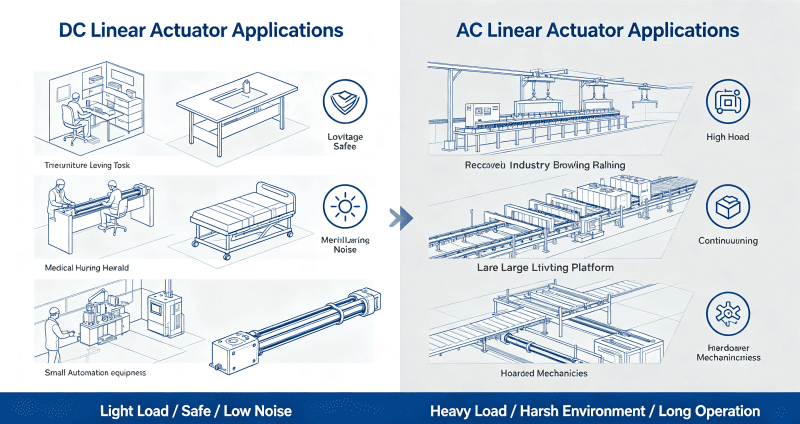
4.1 Choose DC Linear Actuator If:
- The equipment is used indoors or in civilian scenarios with frequent human contact
- The load range is within 2500N, belonging to light and medium load working conditions
- Low noise and high safety are required for equipment operation
- Flexible control and convenient installation and debugging are needed
- The equipment runs intermittently with low continuous operation frequency and no long-hour startup demand
4.2 Choose AC Linear Actuator If:
- The equipment is heavy industrial machinery with load exceeding 3000N
- Long-term continuous uninterrupted operation is required
- The working environment is harsh with high interference and high load impact
- Fixed high-power mechanical movement is needed without frequent speed regulation
- The equipment belongs to large-scale production line equipment and requires long-term stable operation without frequent shutdown
5. Common Selection Mistakes of DC vs AC Linear Actuator
Mistake Reminder: Blindly choosing high-power AC actuators for light-load scenarios or DC actuators for heavy-load continuous operation is the most common error in DC vs AC Linear Actuator selection. Many purchasers only focus on thrust parameters and ignore the essential differences in power supply and working cycle of DC vs AC Linear Actuator, resulting in low equipment matching degree.
- Mismatched Safety Scenarios: Using high-voltage AC linear actuators for household equipment brings electric shock hidden dangers. Civilian scenarios have frequent human operation, and high-voltage AC power supply cannot guarantee user safety, which violates the basic design principle of household intelligent equipment.
- Insufficient Load Capacity: Using DC linear actuators for long-term heavy-load operation causes motor overheating and burnout. Limited by the 10% duty cycle of DC models, long-term continuous operation will accelerate internal motor loss, leading to power attenuation and permanent damage.
- Cost Waste: Purchasing expensive AC actuators for ordinary light-load scenarios increases unnecessary procurement costs. AC models have high purchase and maintenance costs, which is completely uneconomical for low-load intermittent working scenarios.
- Performance Waste: DC actuators cannot exert flexible control advantages in single fixed industrial scenarios, while AC actuators’ fixed-speed design also causes performance redundancy in civilian precision control scenarios.
6. Article Summary
The core of DC vs AC Linear Actuator selection is scenario matching. DC linear actuators are oriented to light-load, safe, low-noise and flexible control scenarios, covering most civilian, medical and light industrial automation needs. AC linear actuators focus on heavy-load, long-term continuous industrial operation scenarios. Users should select according to actual load, working environment and operation requirements after distinguishing DC vs AC Linear Actuator differences, so as to achieve the best use effect and cost performance. Correctly distinguishing and applying DC vs AC Linear Actuator can effectively avoid equipment failure, save project cost and improve the overall stability of automation systems. For professional industry standards and reliable motion control design guidelines, you can refer to NEMA industrial electrical standards to optimize your linear motion system configuration and equipment selection logic.
FAQ
Q1: Which is safer, DC vs AC Linear Actuator?
A1: DC linear actuator is safer. 12V/24V low voltage has no electric shock risk, suitable for human contact scenarios.
Q2: Can DC linear actuators work continuously for a long time?
A2: No. Most DC models have a 10% duty cycle and need intermittent work to avoid overheating.
Q3: Which has lower noise, DC vs AC Linear Actuator?
A3: No. Light and medium-load industrial scenarios can use high-performance DC linear actuators with stable performance.
Q4: Do industrial scenarios must use AC linear actuators?
A4: No. Light and medium-load industrial scenarios can use high-performance DC linear actuators with stable performance.
Q5: Which is more cost-effective, DC vs AC Linear Actuator?
A5: DC linear actuator has lower cost and simpler maintenance for conventional light-load projects.