In long-term industrial and civilian automation operation, Linear Actuator Problems are inevitable due to environmental impact, improper operation and aging wear. Timely and accurate judgment of Linear Actuator Problems and standardized troubleshooting can quickly restore equipment operation, reduce downtime loss and extend actuator service life. Most Linear Actuator Problems are not quality failures but caused by improper use and maintenance.
This article systematically sorts out all common Linear Actuator Problems, analyzes fault causes one by one, provides step-by-step troubleshooting and repair solutions, and summarizes daily maintenance skills to help users completely solve recurring Linear Actuator Problems and avoid repeated failures. Whether you are maintaining smart furniture, medical equipment or industrial machinery, the diagnostic methods and repair steps in this guide apply universally.
Core Maintenance Conclusion: 90% of recurring Linear Actuator Problems are caused by power mismatch, overload operation, environmental corrosion and irregular use, which can be completely avoided through standardized operation and daily maintenance.
Linear Actuator Problems — Startup Failure & No Response
Startup no response is one of the most frequent Linear Actuator Problems. After power on, the actuator does not act and has no sound or movement, which is mostly related to power supply and circuit faults. This type of fault accounts for approximately 35% of all after-sales maintenance requests and is usually the easiest to resolve once the root cause is identified.
Fault Causes
- Linear actuator power supply voltage and current mismatch, insufficient power margin
- Wiring error, positive and negative pole reversal or loose wiring terminal
- Internal circuit aging or short circuit caused by humid environment
- Limit switch failure leading to power-off protection lock
- Controller or remote control signal loss, especially in wireless control systems
- Troubleshooting & Solutions
First check whether the linear actuator power supply voltage matches the actuator specification, test whether the output current is stable, and eliminate power supply faults. A common mistake is using a 12V power adapter for a 24V actuator, which results in insufficient starting torque and no movement. Then check all wiring terminals to ensure firm connection and correct positive and negative pole wiring. For actuators used in humid environments, check for internal circuit corrosion. If the limit switch is stuck and fails, clean or replace the limit switch to restore normal startup. Most startup no-response Linear Actuator Problems can be solved through power supply and circuit inspection.
For wireless control systems, verify that the controller battery is not depleted and that the signal pairing between the remote and receiver is intact. Re-pairing the controller often resolves unexplained startup failures.
Linear Actuator Problems — Operation Jitter & Unstable Movement
Actuator jitter and unstable telescopic movement are common Linear Actuator Problems in light and medium-load operation, which seriously affect equipment operation accuracy. This fault typically appears after 3-6 months of use and gradually worsens if left unaddressed.
Fault Causes
- Insufficient instantaneous current of power supply, unable to support startup load
- Screw and internal transmission gear lack lubrication, increased friction resistance
- Uneven load and eccentric stress during actuator operation
- Loose installation bracket, unstable fixed structure
- Motor brush wear causing intermittent electrical contact
Troubleshooting & Solutions
Replace the matched high-stability power supply to ensure sufficient power margin for instantaneous startup. Regularly clean the internal screw and gear structure and add special lubricating oil to reduce operating friction. Adjust the equipment installation structure to ensure uniform stress of the actuator and avoid eccentric load. Fasten the installation bracket and fixed bolts to eliminate structural shaking. After troubleshooting these points, the jitter Linear Actuator Problems will be completely resolved.
For actuators with brushed motors, if jitter persists after the above steps, inspect the motor brushes for wear. Worn brushes cause intermittent power delivery and can be replaced at low cost without replacing the entire motor assembly.
Linear Actuator Problems — Insufficient Thrust & Slow Speed
Many users encounter Linear Actuator Problems of insufficient propulsion and significantly reduced operating speed after a period of use, resulting in unable to drive normal equipment operation. This is often a gradual degradation rather than a sudden failure, making it easy to overlook until the equipment can no longer function.
H3: Fault Causes
- Long-term overload operation leading to motor performance attenuation
- Excessive load beyond the rated thrust range of the actuator
- Power supply voltage drop, unstable output power
- Serious wear of internal transmission gears and screws
- High operating temperature causing motor thermal throttling
Troubleshooting & Solutions
Check whether the actual load exceeds the rated thrust of the actuator, and replace the heavy-duty linear actuator model if the load is mismatched. Verify the stability of the power supply voltage and current to avoid voltage drop under load. For actuators with long-term operation, check the wear degree of gears and screws, replace severely worn parts, and re-lubricate the transmission structure. Strictly follow the 10% duty cycle standard to avoid long-term overload operation, which can prevent such Linear Actuator Problems from recurring.
If the actuator operates in a high-temperature environment (above 40°C), motor thermal protection may reduce output power. Improving ventilation or adding heat shielding around the motor housing can restore full thrust performance.
Linear Actuator Problems — Abnormal Noise During Operation
Abnormal noise such as gear friction and jamming sound is a typical early warning Linear Actuator Problems, indicating internal structural wear or foreign matter blockage. Ignoring early noise warnings is the leading cause of catastrophic actuator failure, as continued operation with damaged internal components rapidly accelerates wear.
Fault Causes
- Foreign dust and sundries enter the internal transmission structure
- Aging and wear of plastic/metal gears, increased meshing gap
- Dry screw lubrication, rigid friction between structures
- Structural deviation caused by improper installation
- Bearing wear in the motor or gearbox
Troubleshooting & Solutions
Disassemble the actuator shell to clean internal dust and foreign sundries, and keep the transmission structure clean. Check the gear wear degree, replace aging and damaged gears, and readjust the meshing gap. Supplement professional lubricating oil for the screw transmission structure to reduce rigid friction. Recheck and correct the installation position to ensure parallel and stable operation of the actuator. Timely handling of abnormal noise Linear Actuator Problems can avoid subsequent structural damage and equipment failure.
If a grinding or squealing noise originates from the motor end rather than the gearbox, the motor bearings may be failing. Bearing replacement is a cost-effective repair that can extend the actuator life by several years.
Linear Actuator Problems — Automatic Stop & Power Off
Sudden automatic stop and power-off during operation are dangerous Linear Actuator Problems, which easily cause equipment shutdown and production interruption. This fault is often triggered by built-in protection mechanisms rather than actual component failure, making correct diagnosis critical to avoid unnecessary part replacement.
Fault Causes
- Exceeding the rated duty cycle, motor overheating and automatic protection power-off
- Poor heat dissipation of power supply and motor, high-temperature protection trigger
- Limit switch misoperation or failure
- Circuit short circuit caused by water inflow and dampness
- Overcurrent protection triggered by sudden load spikes
Troubleshooting & Solutions
Strictly abide by the actuator duty cycle rules (2 minutes working + 18 minutes resting) to avoid motor overheating. Improve the equipment heat dissipation environment to ensure smooth air circulation around the motor and power supply. Check whether the limit switch is stuck and mis-triggered, clean or replace the faulty switch. For non-waterproof models such as FD10, avoid humid and splashing environments to prevent circuit short circuit. For outdoor or high-moisture applications, select a waterproof linear actuator with IP66 or higher protection rating. Standardizing operation and environment can effectively solve automatic stop Linear Actuator Problems.
For industrial safety compliance, refer to the industrial automation safety standards when designing actuator-driven equipment enclosures and emergency stop systems. Proper machine guarding not only protects operators but also prevents foreign object intrusion that can trigger actuator faults.
If overcurrent protection triggers frequently, inspect the mechanical linkage for binding points that create sudden load spikes. Lubricating pivot points and ensuring free movement of the driven mechanism often resolves recurring overcurrent trips.
Linear Actuator Problems — Unable to Self-Lock & Position Deviation
Position sliding and inaccurate positioning after power off are common Linear Actuator Problems affecting equipment precision. This fault is particularly critical in medical beds, lifting platforms and positioning fixtures where precise hold position is essential for safety and functionality.
Fault Causes
- Serious wear of trapezoidal screw, reduced self-locking performance
- Long-term heavy load leading to structural fatigue deformation
- Unstable load gravity, continuous external force impact
- Backlash accumulation in the gear train
- Mounting bracket deflection under static load
Troubleshooting & Solutions
Check the wear degree of the trapezoidal screw, replace the severely worn screw assembly to restore self-locking performance. Avoid long-term static heavy load on the actuator to prevent structural fatigue. Add auxiliary limit fixing devices for scenarios with continuous external force impact to ensure positioning accuracy. Regularly check the positioning state to eliminate hidden dangers of such Linear Actuator Problems in advance.
For applications requiring high-precision positioning, consider actuators with ball screw designs and integrated brake mechanisms. While trapezoidal screws provide basic self-locking, ball screws with electromagnetic brakes offer superior position hold under dynamic load conditions.
Linear Actuator Problems — Quick Diagnosis Reference Table
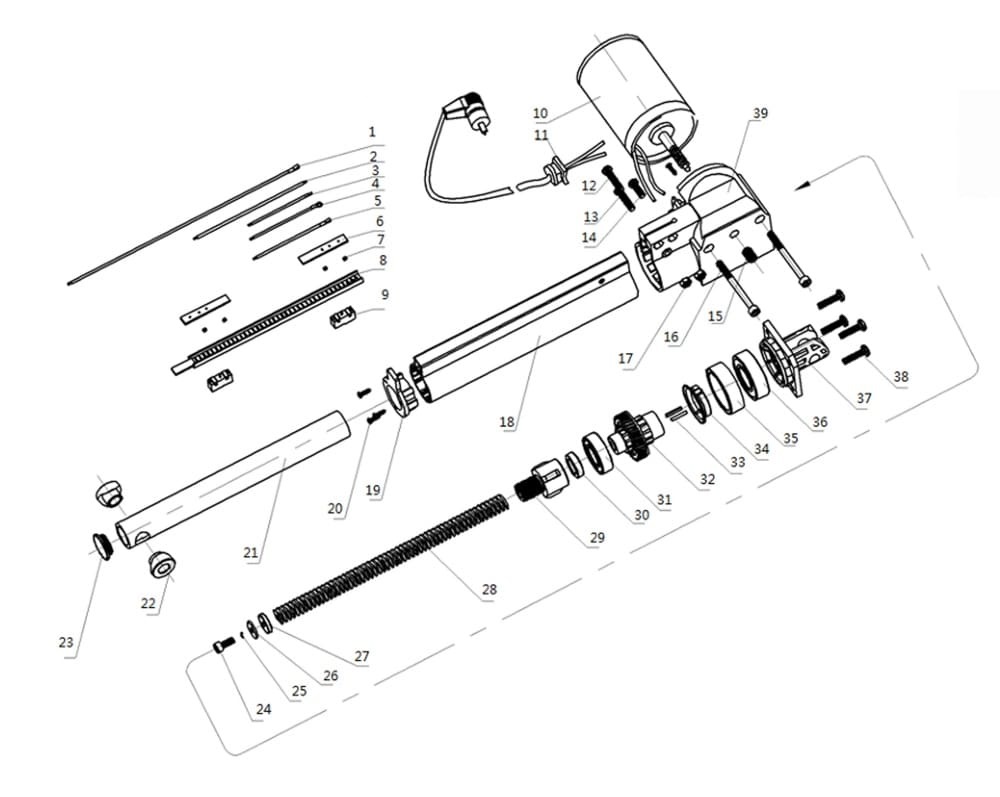
When facing an unknown fault, use this quick reference table to narrow down the cause before beginning detailed disassembly. This table summarizes the most common Linear Actuator Problems, their primary symptoms, and the first diagnostic step.
| Symptom | Most Likely Cause | First Diagnostic Step |
|---|---|---|
| No movement, no sound | Power supply or wiring fault | Measure voltage at actuator terminals |
| No movement, humming sound | Mechanical jam or overload | Disconnect load and test unloaded |
| Jitter during movement | Lubrication or current shortage | Check power supply current rating |
| Slow movement, weak thrust | Overload or voltage drop | Measure voltage under load |
| Grinding or squealing noise | Gear or bearing wear | Locate noise source (motor vs gearbox) |
| Stops mid-stroke randomly | Thermal or overcurrent protection | Check duty cycle and ambient temperature |
| Drifts after stopping | Screw wear or backlash | Test hold position with rated static load |
Using this table can reduce diagnostic time by approximately 60% and prevent unnecessary disassembly of components that are functioning correctly.
Daily Maintenance Skills to Avoid Linear Actuator Problems
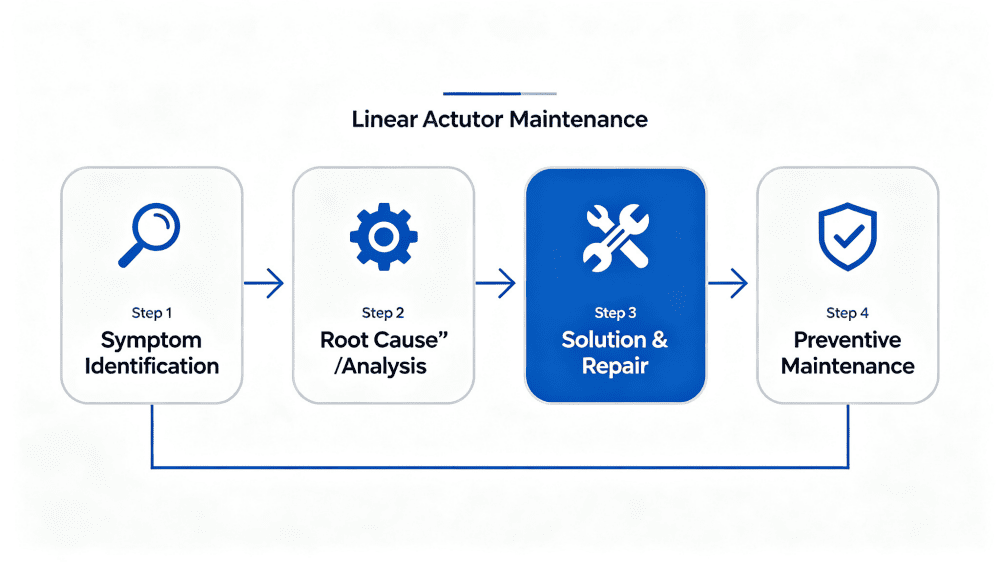
Preventive maintenance is far more cost-effective than reactive repair. Implementing the following five maintenance practices can reduce the occurrence of Linear Actuator Problems by up to 90% and extend the average service life of your actuators by 2-3 years.
- Standard Power Matching: Use matched power supply to avoid voltage and current instability faults. Verify that the power supply can deliver at least 1.5 times the actuator’s peak current requirement.
- Strict Duty Cycle: Follow the 10% duty cycle to prevent motor overheating and aging. For applications requiring continuous operation, select actuators specifically rated for high duty cycle use.
- Regular Lubrication: Lubricate screw and gear transmission structures every 3-6 months to reduce friction wear. Use only lubricants specified by the manufacturer, as incompatible greases can degrade plastic gears.
- Environmental Protection: Non-waterproof models are used indoors, and waterproof models are selected for humid outdoor environments. Regularly inspect sealing gaskets and cable entry points for signs of degradation.
- Regular Inspection: Every 3 months, check wiring terminals, installation structure and parts wear to eliminate faults in advance. Document inspection results to track degradation trends over time.
Additionally, keep a maintenance log for each actuator, recording installation date, total operating hours, lubrication schedule, and any fault events. This log becomes invaluable for predicting end-of-life and planning replacements before unexpected failures occur.
Article Summary
Most Linear Actuator Problems are caused by improper selection, non-standard operation and insufficient daily maintenance, rather than product quality defects. Users can quickly locate and solve common Linear Actuator Problems through the fault classification and troubleshooting steps in this article. Standardizing daily use habits and doing a good job in equipment maintenance can greatly reduce the failure rate of linear actuators and ensure long-term stable operation of automation equipment.
By understanding the root causes of each fault type and implementing systematic preventive maintenance, equipment operators and maintenance technicians can minimize downtime, reduce repair costs, and maximize the return on investment in linear actuator technology.
FAQ
Q1: Why does the linear actuator jitter when starting?
A1: Mostly due to insufficient power supply current margin or lack of internal lubrication, which belongs to common Linear Actuator Problems. Verify that the power supply can deliver the actuator’s peak starting current, and lubricate the screw and gear assembly.
Q2: How to avoid linear actuator overheating failure?
A2: Strictly follow the rated duty cycle and avoid long-term continuous overload operation to solve overheating-related Linear Actuator Problems. Ensure adequate ventilation around the motor housing, especially in enclosed equipment cabinets.
Q3: Can abnormal noise of linear actuator be repaired?
A3: Yes, clean internal foreign matters, replace worn gears and supplement lubricating oil to solve noise Linear Actuator Problems. If the noise originates from motor bearings, bearing replacement is a cost-effective repair option.
Q4: What causes linear actuator positioning deviation?
A4: Screw wear, reduced self-locking performance and external force impact are the main reasons for such Linear Actuator Problems. For high-precision applications, consider actuators with integrated brake mechanisms.
Q5: How to reduce the recurrence of Linear Actuator Problems?
A5: Match parameters reasonably, operate in standard mode and maintain regularly to avoid most common faults. Implement a quarterly inspection schedule and keep a maintenance log for each actuator.
Q6: Can I use a higher voltage power supply to get more thrust?
A6: No. Exceeding the rated voltage will damage the motor winding and trigger overvoltage protection, potentially causing permanent failure. Always use the voltage specified on the actuator nameplate.
Q7: How do I know if my actuator has reached end of life?
A7: Signs include progressively weaker thrust, increased operating noise, frequent thermal protection triggers, and visible wear on the extension tube. If multiple symptoms appear simultaneously, replacement is more economical than repair.