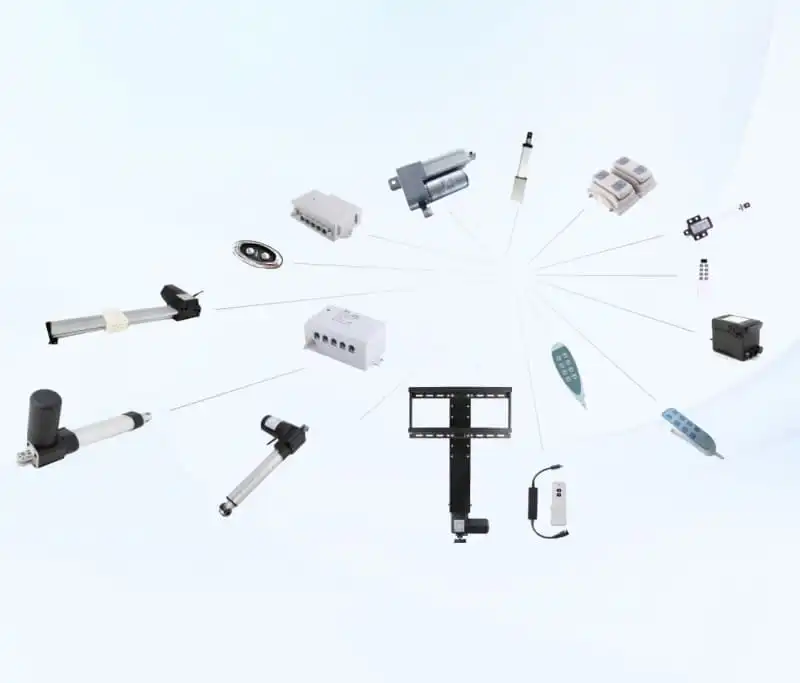
Introduction: Why Choose Compact Linear Actuators for Tight Spaces?
Designing modern machinery and smart equipment is often a game of millimeters. Whether you are building an automated medical testing device, a custom hidden cabinet, an inspection robot, or an adjustable ventilation flap, you probably face the same design puzzle: How do you generate smooth, reliable push-and-pull movement when you only have a few inches of clearance?
In traditional mechanical engineering, moving an object in a straight line required bulky hydraulic lines, noisy pneumatic pumps, or cumbersome motor-and-pulley setups. These legacy systems take up enormous cabinet space, require frequent hose maintenance, and are simply impossible to fit into slim enclosures.
This is where modern compact linear actuators have transformed product design.
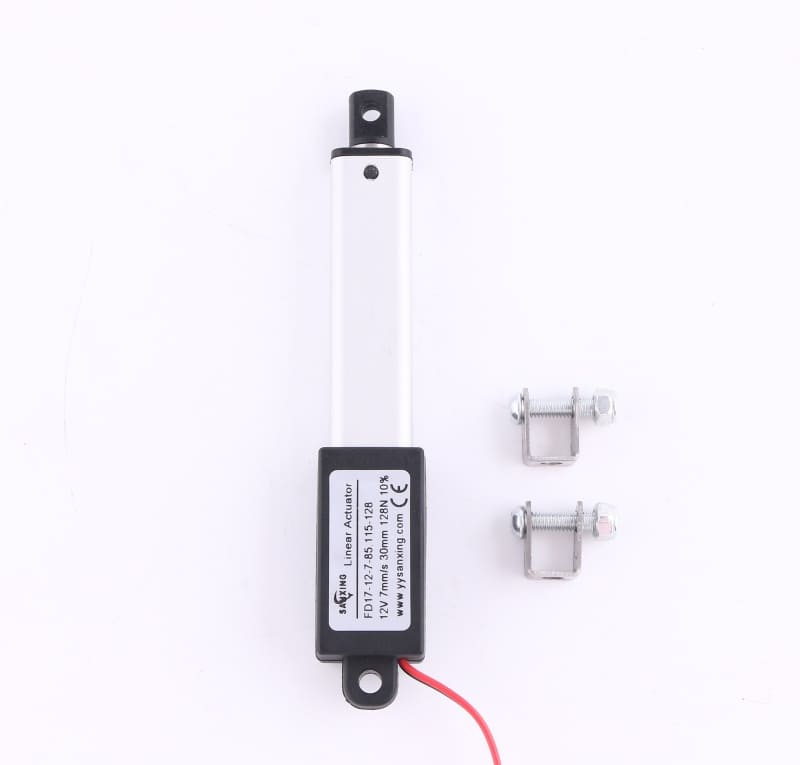
By combining a miniature permanent-magnet DC motor, an internal planetary or spur gearbox, and a precision lead screw into a self-contained tube, compact linear actuators deliver precise straight-line motion in enclosures no wider than a finger.
If you are an engineer, product designer, or equipment builder looking to select the right miniature electric drive, this comprehensive guide will walk you step-by-step through load sizing, stroke calculation, 12V vs. 24V power selection, wiring, and model comparisons.
What Are Compact Linear Actuators and How Do They Work?
At its simplest, a linear actuator is a device that creates motion along a straight line. While standard industrial actuators can be as large as a car jack, compact linear actuators are specially engineered with miniaturized components to keep the outer housing as slim and short as possible.
The Inner Anatomy Simplified
You do not need an advanced robotics degree to understand how these compact devices work. Inside the outer protective housing, there are four core components working together in harmony:
- Miniature DC Motor: Usually powered by 12V DC or 24V DC. When electric current enters the motor, it spins at high speed.
- Reduction Gearbox: Because the tiny motor spins very fast with low turning force (torque), a miniature gearbox reduces the speed while multiplying the turning force.
- Lead Screw & Drive Nut: The gearbox turns a threaded screw shaft. Riding along this screw is a drive nut attached to the inner extending rod. As the screw spins clockwise or counterclockwise, the drive nut travels forward or backward.
- Internal Limit Switches: Built-in micro-switches cut power automatically when the rod reaches full extension or full retraction. This prevents the motor from stalling, overheating, or damaging your mechanical frame.
Because all these elements are sealed inside a single slim cylinder or rectangular aluminum body, compact linear actuators offer a completely plug-and-play motion solution.
Compact Linear Actuators Electrical Specifications: 12V vs. 24V DC Systems
When selecting compact linear actuators for your build, one of the very first decisions you will make is operating voltage. The two industry standards are 12V DC and 24V DC.
| Feature | 12V DC Compact Actuators | 24V DC Compact Actuators |
| Best Suited For | Battery, Mobile, Automotive | Fixed Automation, Industrial Cabinets |
| Operating Current | Higher (~1.5A to 3.5A) | Lower (~0.75A to 2A) |
| Wire Gauge Needed | 24AWG | 24AWG |
| Power Source Type | 12V Lead-Acid / Li-Ion / PSU | 24V Industrial DIN-Rail PSU |
When to Choose 12V DC
- Automotive & Marine Projects: Direct compatibility with standard 12V vehicle batteries without needing step-down converters.
- Portable Battery Devices: Ideal for handheld tools, mobile testing carts, and field robotics running on lightweight 12V Lithium packs.
- Consumer DIY & Smart Home: Plugs directly into widely available 12V wall power adapters.
When to Choose 24V DC
- Industrial Automation Cabinets: Most PLC (Programmable Logic Controller) control boxes operate on a 24V bus standard.
- Long Cable Distances: Lower current draw means less voltage drop across long wiring harnesses.
- Smoother Heat Dissipation: Lower amperage produces less resistive heat in continuous cycling.
Understanding 188N Thrust: What Can It Realistically Move?
A frequent point of confusion among designers is understanding metric force ratings. For instance, our popular ultra-compact model delivers 188N of thrust. But what does 188 Newtons actually feel like in practical applications?
In clear terms, a 188N actuator can reliably lift or push approximately 19 kilograms (over 42 pounds) of direct vertical weight.
| Practical Examples of 188N Thrust: ✓ Opening and latching heavy access panels or skylight vents ✓ Adjusting motorized dampers, airflow louvers, and valves ✓ Raising optical lenses or diagnostic cameras inside medical analyzers ✓ Pushing locking pins in automated security mechanisms ✓ Tilting touchscreens and operator display consoles |
For tight spaces where every cubic centimeter counts, getting over 40 pounds of push force out of a unit smaller than a highlighter pen represents an exceptional power-to-size ratio.
5 Sizing Steps for Compact Linear Actuators in Tight Spaces
When your mechanical enclosure is cramped, selecting compact linear actuators requires careful geometric planning. Follow these five straightforward steps to ensure a flawless fit on your first build:
| [Sizing Workflow: 5 Steps] 1. Measure Retracted vs. Extended Length (Measure the distance between the centers of the two holes) ↓ 2. Calculate Dynamic vs. Static Load Requirements ↓ 3. Determine Travel Speed & Daily Duty Cycle ↓ 4. Match Ingress Protection (IP Rating) to Environment ↓ 5. Plan Power Supply & 2-Wire Polarity Reversal |
Step 1: Measure Retracted Length vs. Stroke Length
The single most common mistake in miniature motion design is forgetting the Retracted Distance (also known as Hole-to-Hole ).
- Stroke Length (S): The active distance the rod travels from fully closed to fully open (e.g., 30mm, 50mm, 100mm, 150mm).
- Retracted Length (A): The total length of the actuator body when fully pulled in (S+55/60mm).
- Extended Length (L): The total length when fully pushed out (S+A).
In space-constrained designs, look for compact linear actuators that offer a minimal dead-length formula (for example: L = Stroke + (S+55/60mm). Always check your 3D CAD envelope before ordering custom stroke lengths.
Step 2: Distinguish Between Dynamic Load and Static Load
- Dynamic Load: The active force required to move the object while the motor is running.
- Static Load (Holding Force): The force the actuator can resist when the power is completely turned off.
Because high-quality compact linear actuators use self-locking acme screws or high-reduction planetary gearings, their static holding force is often equal to or higher than their dynamic push rating. This means your mechanism will not sag, slip, or drop even during a complete power outage.
Step 3: Check Speed vs. Force Trade-offs
In miniature DC motors, speed and force exist in a balance:
- If you need higher speed (e.g., 15mm/s to 30mm/s), the gear ratio will be lower, resulting in moderate push force.
- If you need maximum push force (e.g., 188N or higher), the gear ratio will be higher, resulting in a steady, controlled speed (e.g., 4mm/s to 8mm/s).
Always choose a speed that ensures smooth mechanical movement without jolting delicate components.
Step 4: Environmental Protection and IP Ratings
Dust, moisture, splashing lubricants, and washdowns can destroy unsealed motors. The international st andard for sealing electrical enclosures is defined by the International Electrotechnical Commission (IEC 60529 Ingress Protection Standard).
| • IP54: Protected against limited dust ingress and light water sprays. Great for indoor cabinets. • IP66: Totally dust-tight and protected against powerful high-pressure water jets. • IP68: Hermetically sealed for continuous underwater submersion and extreme outdoor exposure. |
Selecting properly sealed compact linear actuators ensures zero maintenance and eliminates unexpected field breakdowns.
Step 5: Power Supply Sizing
Always size your 12V or 24V power supply with at least a 30% safety headroom. If an actuator draws 1.5A at full mechanical load, choose a power supply capable of delivering at least 2.0A per channel to absorb initial startup current surges.
Pillar Guide: Selecting the Right Miniature Model for Your Application
To help you navigate our specialized product lineup, here is a detailed breakdown of four industry-proven compact linear actuators engineered specifically for space-restricted applications.
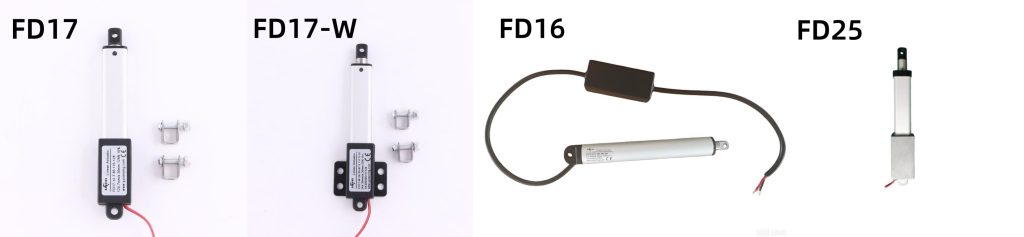
1. FD17: The 188N Ultra-Slim Space Saver
When your design budget allows virtually zero mounting width, the FD17 compact linear actuator is our flagship recommendation.
- Rated Thrust: 188N (~19 kg)
- Standard Operating Voltages: 12V / 24V DC
- Body & Mounting Profile: Ultra-slim aluminum outer tube, ideal for mounting with standard end clevises or collar clamp brackets.
- Key Advantages:
- Fits easily inside narrow profiles, aluminum extrusions, and tight robotic chassis.
- Smooth and controlled mechanical operation, making it ideal for compact industrial and commercial equipment.
- Built-in end-of-stroke limit switches for zero-maintenance operation.
2. FD17-W: Outer Tube with Dual-Sided 4-Hole Mounting Design
The FD17-W compact linear actuator shares the exact same high-efficiency motor, gearbox, 188N thrust capacity, and 12V/24V internal mechanics as the FD17, with the primary distinction being its outer tube mounting design.
- Rated Thrust: 188N (~19 kg)
- Outer Tube Distinction: Specifically engineered with 4 integrated mounting holes on both sides of the outer tube, enabling direct, secure bolt-on fastening directly to your mechanical chassis or structural frame.
- Choosing Between FD17 & FD17-W:
- Choose FD17 if your assembly uses end-clevis pins or external clamp fixtures around a smooth cylindrical body.
- Choose FD17-W if your mechanical design requires direct chassis screw mounting through the dual-sided 4-hole pattern. Both models deliver identical 188N power and stable performance.
3. FD16: IP68 Waterproof Micro-Powerhouse
When conditions involve complete water immersion, outdoor rainstorms, or heavy equipment washdowns, standard miniature drives can fail. The FD16 linear actuator features an IP68 hermetically sealed construction that can operate reliably submerged underwater.
- Protection Level: IP68 Submersible
- Design Profile: Smooth micro-tubular stainless-and-aluminum body
- Ideal Use Cases: Marine hatches, outdoor solar tracking controls, chemical dosing systems, and washdown food processing equipment.
4. FD25: Full-Metal Zinc Alloy Housing with IP66 Protection
The FD25 mini linear actuator shares a very similar compact inline form-factor and identical core performance parameters (188N thrust, 12V/24V DC, customizable stroke) with the FD17 series, but is engineered for applications that require maximum mechanical ruggedness and superior environmental protection.
- Full-Metal Zinc Alloy Motor Housing: Unlike standard lightweight enclosures, the FD25 features a heavy-duty zinc alloy all-metal motor housing that withstands higher mechanical shock and physical impacts (the motor housing envelope is slightly larger than the FD17 to accommodate this reinforced metal construction).
- Interchangeable Metal Front Clevis: The front connector on the extending inner tube can be customized with an all-metal connector head, delivering extra connection strength for high-stress linkage joints.
- IP66 Waterproof & Dust-Tight: Upgraded sealing ensures complete dust protection and resistance against powerful high-pressure water jets.
- Ideal Use Cases: Outdoor automation, agricultural equipment hatches, specialized vehicle dampers, and industrial machinery where heavy-duty metal construction and IP66 durability are required without sacrificing a compact footprint.
Compact Linear Actuators Comparison: FD17-W vs. FD16 vs. FD25
To help you make an immediate, data-backed selection, the following comparison table contrasts our three primary compact models across all essential engineering dimensions:
| Specification / Parameter | FD17-W Compact Actuator | FD16 Micro Linear Actuator | FD25 Mini Linear Actuator |
| Primary Focus | Dual-Sided 4-Hole Direct Mount (188N) | IP68 Underwater Submersion | All-Metal Zinc Alloy Body & IP66 (188N) |
| Max Dynamic Thrust | 188 N (~19.2 kg / 42.2 lbs) | 300 N (~30.6kg / 67.4 lbs) | 188 N (~19.2 kg / 42.2 lbs) |
| Input Voltage Options | 12V DC / 24V DC | 12V DC / 24V DC | 12V DC / 24V DC |
| Ingress Protection Rating | IP54 | IP68 (Full Submersion Capable) | IP66 (Heavy Washdown / Dust-Tight) |
| Housing Material & Body | Tubular Stainless & Aluminum Body (4-Hole Outer Tube) | Tubular Stainless & Aluminum Body | Full-Metal Zinc Alloy Motor Housing |
| Front Connector Options | Standard Clevis ( Plastic ) | Standard Clevis (Metal) | Standard or Metal Clevis Head |
| Standard Stroke Range | 10 mm to 150 mm (Customizable) | 10 mm to 800 mm (Customizable) | 10 mm to 150 mm (Customizable) |
| Limit Switch Integration | Dual Built-in Micro Switches | Dual Built-in Micro Switches in the box | Dual Built-in Micro Switches |
| Operating Temperature | -10°C to +50°C | -25°C to +80°C | -10°C to +50°C |
| Typical Operating Noise | ≤55 dB | ≤55 dB | ≤55 dB |
| Recommended Mounting | Direct Chassis Bolt-On (4-Hole) / Clevis | Round Clevis Pins | Heavy-Duty Clevis / Metal Mounts |
| Best Application Fit | Medical carts, tight robotics, smart furniture flaps | Marine equipment, outdoor solar, washdown machinery | Heavy outdoor fixtures, vehicles, rugged machinery |
Real-World Applications Where Compact Linear Actuators Excel
Because compact linear actuators eliminate bulky hydraulic plumbing and noisy air lines, design teams across diverse industries use them to solve unique spatial challenges.
1. Healthcare Equipment & Medical Care Carts
In mobile medical carts, optometry examination stations, and diagnostic equipment covers, motorized components must adjust smoothly within slim column profiles. Compact linear actuators like the FD17 maintain a controlled acoustic level ($\le 55\text{ dB}$), providing dependable push-and-pull adjustments for monitor mounts, access panels, and specialized healthcare equipment.
2. Robotics & Automated Grippers
Mobile inspection robots and automated guided vehicles (AGVs) must stay lightweight to conserve battery power. Using low-weight, high-thrust compact linear actuators allows engineers to create motorized grippers, sensor-tilting masts, and steering lockouts without adding unnecessary dead weight to the mobile platform.
3. Smart Furniture & Hidden Motorized Architecture
High-end residential and commercial architecture frequently demands hidden motorized features:
- Concealed TV lifts and pop-up power outlets
- Secret drawer locks and motorized liquor cabinets
- Motorized architectural louvers and automated acoustic panels
Because these actuators fit effortlessly behind drywall, within table legs, or under shallow baseboards, they provide clean, invisible automation.
4. Automotive Air Management and Flap Positioning
Modern electric vehicles (EVs) and specialized utility trucks utilize active aerodynamics and motorized climate baffles to optimize thermal efficiency. Compact linear actuators are frequently specified for active grille shutters, air-conditioning damper gates, and charging-port locking pins due to their wide operating temperature tolerance (-20°C to +65°C).
5. Industrial Diverters and Sorting Gates
On busy conveyor lines, rejected parts or barcode-routed packages must be rapidly diverted into secondary bins. Miniature actuators provide instant, high-repetition pushing power without requiring a noisy air compressor on the production floor.
How to Wire and Control Compact Linear Actuators
One of the greatest benefits of 2-wire DC compact linear actuators is how simple they are to wire and control.
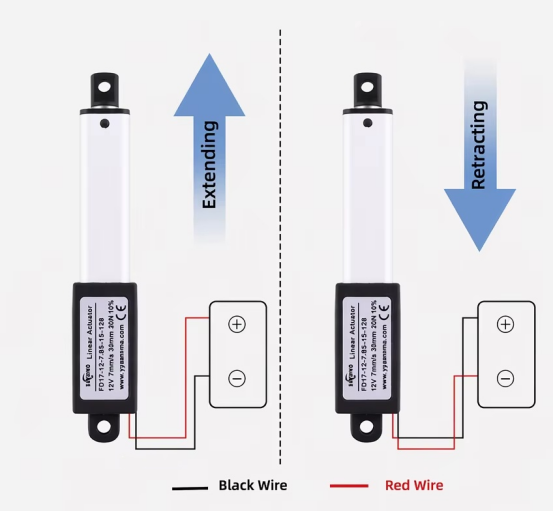
| [2-Wire Polarity Reversal Concept] Forward (Extend): (+) Positive Terminal —> Red Wire (-) Negative Terminal —> Black Wire ==========================> Rod Extends Outward Reverse (Retract): (+) Positive Terminal —> Black Wire (-) Negative Terminal —> Red Wire ==========================> Rod Retracts Inward |
1. Simple Rocker Switch Control (Manual DPDT)
Using a standard Double-Pole Double-Throw (DPDT) momentary rocker switch, you can achieve forward, reverse, and stop control with zero microcontrollers or programming required. When the switch is released, power is removed and the internal screw mechanism holds the position firmly.
2. Relay Board & Microcontroller Integration (Arduino / PLC / Raspberry Pi)
For automated setups, a standard dual-relay module (or H-bridge motor driver) connects directly to your digital outputs:
- Relay 1 ON, Relay 2 OFF: Actuator extends until the internal limit switch triggers.
- Relay 1 OFF, Relay 2 ON: Actuator retracts fully.
- Both Relays OFF: Actuator brakes and holds its current position.
Compact Linear Actuators: Frequently Asked Questions (FAQ)
Q1: Can I stop a compact linear actuator at any position along the stroke?
A: Yes. While the built-in limit switches will stop the actuator automatically at the full extension and retraction limits, you can halt the actuator at any intermediate point simply by cutting the DC power. The self-locking gearbox and screw mechanism will firmly hold the position under load.
Q2: What happens if an external obstruction blocks the actuator while extending?
A: If an immovable object blocks the travel before reaching the limit switch, the motor will experience a situation of being stuck in rotation condition. Staying in this state for a long time will damage the motor. We recommend adding an inline current-limiting fuse or choosing a smart control box with electronic over-current protection for automated equipment.
Q3: Can I synchronize two compact linear actuators to move together?
Yes, two actuators can be wired and operated in parallel from the same power source, but they will not achieve 100% precise synchronization.
Because miniature DC motors have slight manufacturing variations in internal winding resistance and mechanical gearbox friction, two parallel units will run at slightly different speeds, typically resulting in a minor travel time discrepancy of around 1 second over a full stroke cycle.
Achieving true, closed-loop synchronous movement requires built-in Hall effect sensors and an intelligent synchronized control box. Due to the ultra-slim structural limits of the micro-cylindrical housing, our compact FD17/FD25 micro series currently does not support built-in Hall sensors. If your mechanical setup can accommodate a slight (~1s) travel variation (such as independent access flaps or hinged panels with mechanical tolerance), parallel operation works reliably. If your project demands strict synchronization, please contact our engineering team to explore our larger actuator series that support integrated Hall feedback.
Q4: Are custom stroke lengths and mounting brackets available?
A: Yes. While standard stroke lengths (such as 30mm, 50mm, 100mm, 150mm, and 200mm) cover most projects, specialized strokes (e.g., 42mm or 88mm) and tailored front/rear mounting clevises can be custom-manufactured to match your exact mechanical CAD envelope. We could supply 3D if you require.
Accelerate Your Project with Sanxing Actuator
Are you currently working on a space-constrained machine, medical device, or automation project? Finding the exact balance of stroke length, thrust rating, and mounting clearance is much easier when you work with experienced motion specialists.
At Yuyao Sanxing Mechanical & Electrical Technology, we have engineered and manufactured precision electric linear actuators for over 18 years. Whether you need a standard sample of the 188N ultra-slim FD17, an IP68 submersible FD16, or a fully customized OEM/ODM motion solution with tailored cables and brackets, our engineering team is here to assist.
What We Offer for Engineers and OEM Buyers:
- Free 2D/3D CAD Models (DWG/STEP files) for fast virtual fitting
- Rapid Prototyping Samples delivered directly to you for test
- Direct Factory Pricing & Low MOQ for volume manufacturing
- Technical Sizing Support from experienced motion engineers
👉 [Contact our Engineering Team Today] with your required input voltage, stroke, installation distance, thrust and speed, or send your inquiry directly to receive a comprehensive quote and CAD files within 24 hours!