
When you are sourcing heavy-duty linear actuators for industrial automation projects, it is common to get stuck between two high-thrust models, and Sanxing FD1 VS FD13 Heavy-Duty Linear Actuator is one of the most frequently asked comparison requests from our engineering customers. Both FD1 and FD13 are heavy duty linear actuators built for harsh industrial environments, but they are designed for different load requirements, installation space and budget. Understanding every specification gap in Sanxing FD1 VS FD13 Heavy-Duty Linear Actuator will help you avoid over-specifying and wasting budget, or under-sizing and facing premature equipment failure. This comprehensive comparison breaks down thrust, stroke, speed, mounting dimension, footprint, protection rating, price and application scenarios of these two models, to help you select the correct heavy duty linear actuator between 8000n linear actuator vs 6000n linear actuator.
In industrial motion automation, actuator selection is never based on thrust data alone. Many system integrators only focus on maximum pushing force and ignore installation constraints, ambient temperature tolerance, stroke length, speed requirement, continuous working stability and structural compatibility. This often leads to prototype rework, field failure, increased maintenance cost and delayed project delivery. For engineers who need stable, long-lifespan linear motion solutions for outdoor, workshop and heavy-load scenarios, comparing Sanxing FD1 VS FD13 Heavy-Duty Linear Actuator in full dimension is essential before finalizing BOM and mechanical design.
Overview of Sanxing FD1 and FD13 Heavy-Duty Linear Actuator Series
The Sanxing FD series is our core heavy-duty linear actuator product line developed for industrial and outdoor automation, covering different thrust ranges from low force up to 8000N. FD1 and FD13 are two popular high-thrust options, and many system integrators will compare Sanxing FD1 VS FD13 Heavy-Duty Linear Actuator in the early stage of mechanical design. Both series adopt industrial-grade aluminum alloy housing, built-in limit protection and standard low-voltage DC power supply design, fully compliant with international industrial automation safety standards. Although they share the same FD-series industrial design genes, their internal transmission structure, load tolerance and environmental adaptability are customized for different industrial segmentation scenarios.
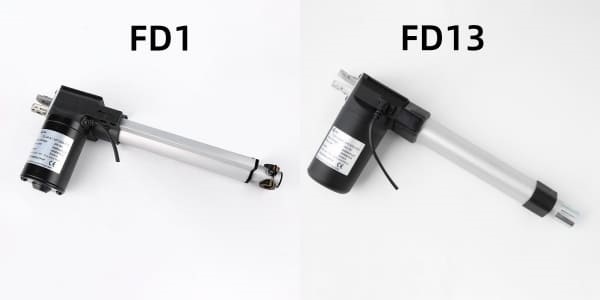
What Is Sanxing FD1 8000N Linear Actuator
Sanxing FD1 linear actuator is the high-thrust workhorse of our FD series, rated for maximum 8000N push force / 6000N pull force. It is engineered for heavy load lifting jobs. Sanxing FD1 linear actuator supports stroke lengths from 26mm up to 1000mm (customizable stroke), and it comes with an optional FD1-Y variant fitted with manual hand crank. In case of power outage, maintenance staff can manually extend or retract the actuator, which is a critical safety feature for large lifting equipment. The actuator housing uses powder coated aluminum alloy and IP44 ingress protection, suitable for dusty industrial sites. When customers compare Sanxing FD1 VS FD13 Heavy-Duty Linear Actuator, FD1 is always the pick when the working load approaches or exceeds 6000N.
The internal transmission structure of Sanxing FD1 linear actuator adopts thickened alloy gear set and enhanced trapezoidal lead screw, which greatly improves structural rigidity and anti-impact capability. This structural upgrade allows FD1 to maintain stable output even under frequent variable load and instantaneous impact load, which is why it is widely trusted in heavy industrial machinery scenarios that require high stability and high safety redundancy. The optional manual emergency function further differentiates FD1 from conventional high-thrust actuators, providing irreplaceable safety guarantee for unattended equipment and large mechanical structures.
What Is Sanxing FD13 6000N Linear Actuator
Sanxing FD13 linear actuator is a compact high-thrust model with a maximum dynamic thrust of 6000N push force / 4000N pull force. While Sanxing FD13 delivers slightly lower thrust than FD1, it has a shorter minimum mounting distance and better low-temperature working performance. Sanxing FD13 linear actuator is factory fitted with built-in limit switches, no extra wiring is required for stroke end stop control. Its operating temperature range extends down to -20℃, making it ideal for cold region outdoor equipment. In Sanxing FD1 VS FD13 Heavy-Duty Linear Actuator analysis, FD13 is the preferred option when your load stays under 6000N and you have limited installation space.
Sanxing FD13 focuses on structural miniaturization and environmental adaptability optimization. While retaining industrial IP66 waterproof and dustproof performance, it optimizes the internal gear transmission ratio and shell structure design, effectively reducing the overall body size and minimum installation spacing. The low-temperature resistant internal lubricating grease and enhanced sealing process enable FD13 to work stably in long-term low-temperature outdoor environments without jamming, slow response or sealing aging, which makes it the first choice for agricultural automation and northern outdoor engineering equipment.
Core Differences Between Sanxing FD1 VS FD13 Heavy-Duty Linear Actuator
The most intuitive difference between Sanxing FD1 VS FD13 Heavy-Duty Linear Actuator is the rated thrust, but multiple other parameters will affect your mechanical design and long-term reliability. We will break down each difference and present the full comparison table for Sanxing FD1 VS FD13 Heavy-Duty Linear Actuator. Professional actuator selection must comprehensively consider load margin, installation space, ambient temperature, working cycle, maintenance difficulty and project budget, rather than relying solely on single thrust parameter.
Full Parameter Comparison Table: Sanxing FD1 VS FD13 Heavy-Duty Linear Actuator
| Parameter | Sanxing FD1 Linear Actuator | Sanxing FD13 Linear Actuator |
|---|---|---|
| Max Push Force | 8000N | 6000N |
| Max Pull Force | 6000N | 4000N |
| Stroke Range | 26mm ~ 1000mm (customizable) | 30mm ~ 1000mm (customizable) |
| Minimum Installation Distance | Stroke + 150mm | Stroke + 160mm |
| IP Rating | IP44 | IP66 |
| Operating Temperature | -20℃ ~ +40℃ | -20℃ ~ +40℃ |
| Duty Cycle | 10%, stop for 18 mins after continuous working 2 mins | 10%, stop for 18 mins after continuous working 2 mins |
| Noise Level | ≤48dB | ≤48dB |
| Housing Material | Aluminum Alloy, Plastic, Zinc Alloy, Iron | Aluminum Alloy, Plastic, Zinc Alloy, Iron |
| Power Supply | 12VDC / 24VDC | 12VDC / 24VDC |
| Limit Switch | Built-in | Built-in |
| Optional Functions | Hall Sensor, Synchronization; FD1-Y with hand crank | Synchronization |
| Typical Load Scenario | Heavy lifting, large mechanical hatch, emergency manual operation available | Medium load, outdoor farm machinery, assembly line, wet & dusty environment |
| Relative Cost | Higher | Cost effective |
Thrust Performance Difference: 8000N vs 6000N
Thrust rating is the primary factor when buyers compare Sanxing FD1 VS FD13 Heavy-Duty Linear Actuator. Sanxing FD1 delivers up to 8000N push / 6000N pull force, while Sanxing FD13 offers up to 6000N push / 4000N pull force. When calculating the required force for your mechanical design, always add a 20% to 30% safety margin on top of your actual working load. If your continuous working load sits around 5500N, Sanxing FD13 can handle it safely. If your peak load hits 7000N or higher, Sanxing FD1 8000N linear actuator is required.
Many customers make a mistake in Sanxing FD1 VS FD13 Heavy-Duty Linear Actuator selection by matching the actuator rated thrust exactly to their working load without safety buffer. Dynamic load spikes during startup or movement can easily overload the actuator, leading to gear wear and shortened service life. For heavy lifting platforms and large machinery hatches, sudden load shift often happens, so reserving enough thrust margin is essential. In actual industrial operation, the load borne by the actuator is not constant. Factors such as equipment inclination, friction aging, dust accumulation and seasonal temperature changes will increase actual operating resistance. Therefore, sufficient thrust redundancy is the core guarantee for long-term stable operation of automated equipment.
Stroke and Speed Difference
When comparing Sanxing FD1 VS FD13 Heavy-Duty Linear Actuator, stroke length and operating speed are two practical parameters that directly affect machine cycle time and design flexibility. Sanxing FD1 supports stroke starting from 26mm up to 1000mm, making it more suitable for applications that require short stroke or long linear displacement, such as heavy lifting platforms, large hatches and long-stroke industrial mechanisms. Sanxing FD13 covers stroke from 30mm up to 1000mm, which is sufficient for most agricultural machinery, assembly line fixtures and medium-load outdoor equipment.
Speed is equally important. If your system requires fast action or high throughput, a small thrust model with higher speed may perform better than a high-thrust model with slower extension speed. In Sanxing FD1 VS FD13 Heavy-Duty Linear Actuator comparison, you should check both load and speed together. A high-thrust actuator running at low speed will reduce cycle efficiency, while a compact actuator with moderate thrust and higher speed may improve overall equipment performance. Always confirm the speed under your actual working load instead of only reviewing the no-load speed in the datasheet.
Minimum Mounting Distance & Footprint Comparison
The footprint and minimum mounting distance is another key point in Sanxing FD1 VS FD13 Heavy-Duty Linear Actuator comparison. Sanxing FD1 needs a minimum installation distance of Stroke + 150mm. Sanxing FD13 needs Stroke + 160mm. FD1 has a shorter mounting base, which is helpful when the available installation length is tight. FD13 body is optimized for waterproof sealing structure, so its minimum installation dimension is slightly longer. For mechanical designers working in tight space, Sanxing FD1’s shorter mounting dimension is a big advantage. If your machine frame cannot reserve enough installation length, Sanxing FD13 may not fit even if the thrust is sufficient.
Footprint also influences cabinet and frame design. Sanxing FD1 has a body structure to support the 8000N heavy load internal gear system. Sanxing FD13’s sealed waterproof body is designed for splash and dust environment. When you compare Sanxing FD1 VS FD13 Heavy-Duty Linear Actuator, always confirm your mechanical drawing’s available mounting space before locking the model. In many automated assembly lines and small outdoor mechanical equipment, the internal installation space is extremely limited, and the oversized actuator structure will directly interfere with the motion trajectory, resulting in equipment failure.
IP Protection, Temperature Range and Duty Cycle
When evaluating Sanxing FD1 VS FD13 Heavy-Duty Linear Actuator, the IP rating difference is a very important distinction. FD1 is IP44, it can resist solid particle ingress and prevent water splashing, suitable for indoor workshop environment. FD13 is IP66, fully dust-tight and resistant to high-pressure water jets, works reliably in outdoor, rainy and heavy splash scenarios.
Both models have operating temperature range: -20℃ ~ +40℃. The duty cycle for FD1 and FD13 is 10%, meaning they can continuously run for 2 minutes, then must stop for 18 minutes to cool down. If your application requires continuous frequent operation, customized duty cycle upgrade can be done for either Sanxing FD1 or Sanxing FD13.
The environmental adaptability difference is critical for long-term outdoor projects. If your equipment will be exposed to rain, spray and heavy dust, FD13 IP66 is the mandatory selection. If the actuator works inside clean and dry workshop, FD1 IP44 is enough and saves cost.
Cost and Commercial Price Difference
When evaluating Sanxing FD1 VS FD13 Heavy-Duty Linear Actuator, budget is unavoidable. Sanxing FD1 uses stronger internal gear and screw structure to achieve 8000N thrust, so its unit price is higher than FD13. If your load requirement can be fully covered by Sanxing FD13, choosing Sanxing FD13 will reduce your component cost without sacrificing reliability. Choosing Sanxing FD1 only when your project truly needs the extra thrust capacity avoids unnecessary overspending.
For large-scale batch automation projects, component cost control directly determines the overall profit margin of the equipment. Blindly selecting higher-thrust actuators will lead to increased procurement costs and unnecessary structural design redundancy. Reasonable matching of Sanxing FD1 VS FD13 Heavy-Duty Linear Actuator according to actual working conditions can help equipment manufacturers achieve precise cost control while ensuring equipment stability.
Suitable Applications for Sanxing FD1 and FD13 Linear Actuator
Sanxing FD1 and FD13 are built for different industrial scenarios. Selecting the right model in Sanxing FD1 VS FD13 Heavy-Duty Linear Actuator depends on what type of equipment you are building. Although both are high-thrust industrial actuators, their scenario positioning is clearly differentiated after industrial iteration and market verification.
Sanxing FD1 8000N Actuator for Heavy Machinery & Large Lifting Platform
Sanxing FD1 linear actuator is widely used for construction machinery, heavy-duty lifting platforms and large mechanical hatch opening systems. These applications have heavy static and dynamic load, sometimes with sudden impact force. The optional FD1-Y manual hand crank version adds safety for power failure emergency. Large industrial lifting equipment operators often choose Sanxing FD1, as the backup manual operation prevents equipment stuck in raised positions during power loss. Sanxing FD1 8000N linear actuator also works for large warehouse gate and heavy material handling mechanism.
In heavy industrial scenarios, equipment safety redundancy is always the first design principle. Once the lifting platform, large hatch and heavy-duty turnover mechanism fail to move due to power failure, it may cause equipment stuck, production halt and even safety accidents. The manual emergency function of Sanxing FD1 series perfectly solves this pain point, which is why it is widely recognized in heavy industry and large automation equipment fields.
Sanxing FD13 6000N Actuator for Agricultural Equipment & Assembly Line
Sanxing FD13 linear actuator is popular in agricultural automation and factory production line automation. Farm machinery like greenhouse ventilation hatches, grain bin doors and farm harvesting attachments often have medium load and require waterproof performance. Sanxing FD13’s IP66 rating fits outdoor farm equipment perfectly. On factory assembly lines, Sanxing FD13 drives small material pushers and fixture adjustment structures. The built-in limit switch simplifies wiring work for machine builders.
Agricultural automation equipment has the characteristics of long-term outdoor exposure, large temperature difference between day and night, dusty environment and occasional water splash. Sanxing FD13’s IP66 waterproof and dustproof performance can fully adapt to harsh farm working conditions. At the same time, its cost-effective advantage helps agricultural equipment manufacturers reduce overall equipment costs and improve market competitiveness.

When to Choose Sanxing FD1 Linear Actuator for Your Project
After reviewing Sanxing FD1 VS FD13 Heavy-Duty Linear Actuator comparison, pick Sanxing FD1 linear actuator if any of the below conditions apply:
- Your peak dynamic working load exceeds 6000N, after adding 20~30% safety margin
- Your project requires emergency manual operation during power cut, FD1-Y hand crank version needed
- Short stroke requirement starting at 26mm
- Heavy duty lifting platform or large industrial hatch application, indoor workshop environment
- The equipment may face sudden impact load during operation
For engineering projects that pursue high safety redundancy and high load stability, Sanxing FD1 is the most reliable high-thrust solution. Its enhanced mechanical structure and optional manual emergency function make it irreplaceable in heavy industrial automation scenarios.
When to Choose Sanxing FD13 Linear Actuator for Your Project
Select Sanxing FD13 linear actuator after Sanxing FD1 VS FD13 Heavy-Duty Linear Actuator evaluation if:
- Working load stays below 6000N push force with safety margin included
- Equipment works outdoors or in wet, splash-prone environment (IP66 required)
- Agricultural machinery or factory assembly line automation
- You want to optimize component cost without sacrificing required performance
Sanxing FD13 is a cost-effective and waterproof high-thrust actuator, which is very suitable for standardized medium-load automated equipment mass production projects. It can balance performance, cost and environmental adaptability to the greatest extent.
Common Selection Mistakes When Comparing High Thrust Linear Actuators
Many integrators make mistakes when comparing Sanxing FD1 VS FD13 Heavy-Duty Linear Actuator, leading to rework after prototype testing. The first mistake is only comparing rated thrust and ignoring IP rating. If your site has water spray, FD1 IP44 cannot meet the requirement, FD13 IP66 must be selected.
Second mistake: neglecting minimum installation distance. Even if 8000N Sanxing FD1 matches your load, it may not fit inside your machine frame. Always cross-check mechanical drawing dimensions.
Third mistake: over-buying thrust. Some engineers always select the higher thrust model out of safety concern, but Sanxing FD1 will increase your project cost. Proper calculation and safety margin is enough, no need to oversize.
Fourth mistake: ignoring duty cycle. Both Sanxing FD1 and FD13 have standard 10% duty cycle. Continuous non-stop operation will overheat the actuator regardless of whether you pick Sanxing FD1 or Sanxing FD13 in Sanxing FD1 VS FD13 Heavy-Duty Linear Actuator comparison. Reasonable working cycle design and intermittent heat dissipation are necessary conditions to ensure long service life of industrial actuators.
Fifth mistake: separating stroke, speed and thrust. Some engineers select an actuator only by maximum thrust and then find that the stroke is too short or the speed is too slow for the actual machine cycle. In Sanxing FD1 VS FD13 Heavy-Duty Linear Actuator comparison, you should evaluate thrust, stroke and speed as a system, not as isolated parameters. If your application requires both short stroke and high load, Sanxing FD1 is more likely to be the correct choice. If your application requires waterproof and moderate load, Sanxing FD13 may deliver better overall value.
For linear actuator mechanical design and force calculation guidance, you can check the American Society of Mechanical Engineers resource library: ASME Linear Motion Systems Guide, a trusted non-commercial industrial engineering reference.
FAQ
Q1: What is the main difference between Sanxing FD1 and FD13 linear actuator?
A: Sanxing FD1 linear actuator delivers up to 8000N push / 6000N pull force, IP44 rated, supports stroke from 26mm, optional FD1-Y manual hand crank for emergency operation. Sanxing FD13 linear actuator delivers up to 6000N push /4000N pull force, IP66 waterproof & dustproof, stroke starts at 30mm, better for outdoor wet environments. This is the core difference in Sanxing FD1 VS FD13 Heavy-Duty Linear Actuator comparison.
Q2: Are Sanxing FD1 and FD13 both IP66 waterproof?
A: No. Sanxing FD1 is IP44, suitable for indoor workshop. Sanxing FD13 is IP66 dust-tight and water jet resistant for outdoor use.
Q3: What is the minimum installation distance difference between Sanxing FD1 and FD13?
A: Sanxing FD1 minimum installation distance = Stroke +150mm. Sanxing FD13 minimum installation distance = Stroke +160mm. FD1 has shorter mounting length.
Q4: What is the duty cycle of FD1 and FD13?
A: Both FD1 and FD13 have 10% duty cycle: max continuous working time 2 minutes, then 18 minutes cooling period.
Request For Quotation – Free Linear Actuator Sizing Support
If you are still unsure which model to select after reviewing Sanxing FD1 VS FD13 Heavy-Duty Linear Actuator comparison, send your project parameters to our engineering team for free sizing support. Please share your required working load, stroke length, available mounting space, working temperature, application type and power supply requirements. Our engineers will evaluate your case, recommend between 8000n linear actuator vs 6000n linear actuator, provide product datasheet, 2D drawing and formal quotation for your project.
If you want to learn more about selecting waterproof heavy duty actuators for outdoor harsh environment, read our guide about IP66 Waterproof FD13 Heavy Duty Linear Actuator For Harsh Industrial Equipment & Outdoor Machinery Motion Control.
