
How to Select Medical Linear Actuators for Patient Lifts and Beauty Chairs (2026)
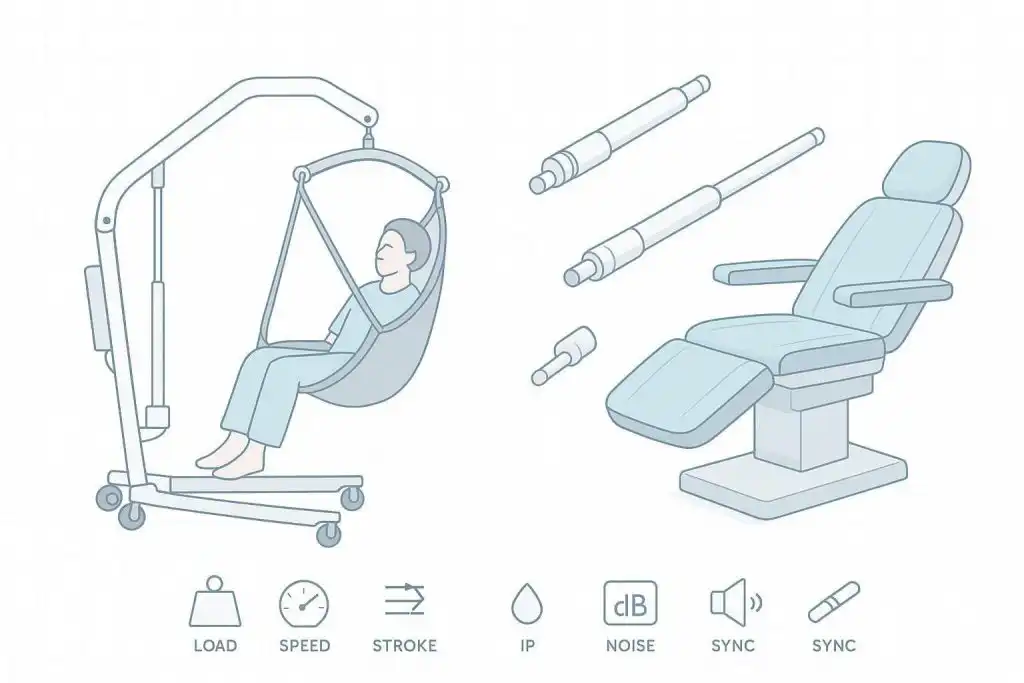
Medical device R&D teams face a specific job to be done: select an actuator and control stack that’s safe, quiet, compact, certifiable, and still flexible enough to meet real packaging constraints. This medical linear actuator comparison focuses on two high-impact applications—patient lifts and beauty or aesthetic treatment chairs—anchored on customization breadth across load, speed, stroke, synchronized motion, and controls.
We cite primary sources inline where available, and we keep claims at the system reality level: compliance is ultimately verified on the finished device, not a standalone actuator. For scope, treat pricing as indicative only (see the dedicated section).
Quick verdict
- Patient lifts: Favor systems with documented patient lift intent, emergency lowering, and washable IP. The LINAK Medline Careline ecosystem featuring LA40 PL with LIFT and JUMBO components is widely referenced in official manuals, including emergency procedures and battery integration, making it a dependable baseline for safety-first designs, as outlined in the Medline Careline linear actuators user manual and the LIFT/JUMBO manuals.
- Beauty and aesthetic chairs: Prioritize low noise, compact form factors, and fine positioning with memory. Sanxing’s FD18 emphasizes low noise and broad stroke configurations for quiet adjustments per the FD18 3000 N low-noise page, while compact options like FD17 variants fit tight enclosures per the FD17 compact page.
Master table for fast scanning
Use this as a starting point, then pull the exact datasheet for your target SKU and validate at load.
| Vendor | Representative model | Application bucket | Max push N | Typical speed mm/s | Stroke range mm | IP rating | Noise note | Feedback and sync | Emergency and battery | Customization breadth | Compliance note | Constraint note | Evidence |
|---|---|---|---|---|---|---|---|---|---|---|---|---|---|
| LINAK | LA40 PL with LIFT/JUMBO | Patient lifts | 8000 | Datasheet dependent | Datasheet dependent | IPX6 and Washable frameworks in ecosystem | Healthcare comfort targets | OpenBus sync via control boxes | Emergency lowering and battery packs at system level | Broad controls/accessories | Verified at system per IEC 60601; PL variant aimed at lifts | Confirm stroke/speed on current LA40 PL datasheet | LINAK LA40 data sheet overview and healthcare user manual |
| TiMOTION | TA23 family | Lifts and beds | up to 10000 | up to ~39 | Model dependent | IP66W options in series context | Medical-furniture level | Hall feedback common; sync via controllers | Battery/control boxes available | Wide medical lineup | System-level IEC 60601 verification | Confirm exact options per SKU | TiMOTION IP ratings explainer and hospital beds article |
| DewertOkin | Medical drive/columns portfolio | Beds and chairs | Category dependent | Category dependent | Category dependent | Medical IP options by model | Designed for patient comfort | Sync/memory via matching controls | Emergency functions via system design | Mature ecosystem | Compliance addressed at system level | Pull model PDFs for specifics | DewertOkin medical double drives overview |
| Sanxing | FD1, FD6, FD13, FD18 set | Lifts and beauty chairs | up to 8000 (FD1) | Configuration dependent | 26–1000 depending on model | IP66 on FD13; IP54/IP44 on others | FD18 and FD6 specified ≤48 dB | Hall and optional sync on select models | Validate battery/manual release in system | Broad build‑to‑order across stroke/load/speed/voltage | System-level IEC 60601 verification | Confirm controller pairing and cert scope | FD1 8000 N, FD6 medical, FD13 IP66 + sync, FD18 low‑noise |
Notes on columns
- Compliance note means published guidance or intent; certification is confirmed on your finished device per IEC 60601-1 and -1-2. For patient hoists, check EN ISO 10535 scope at the system level via the EU Commission document page.
- Noise note is vendor-supplied unless otherwise stated; always measure dB(A) at your nominal loads to avoid surprises.
How to read this medical linear actuator comparison
- System first: IEC 60601-1 and 60601-1-2 are verified on the assembled product. Component readiness helps, but your risk management and EMC tests seal the deal. LINAK’s healthcare manuals and control box documentation illustrate how emergency and battery behaviors are handled at the system layer, see the control boxes user manual.
- IP realism: IPX6 vs IP66 or IP66W differs in water ingress tests and washability expectations. TiMOTION’s article explains IP codes and lubrication for medical actuators, while the LINAK LA40 data sheet overview describes IPX6/Washable frameworks used in healthcare ecosystems. If cleaning chemicals are aggressive, validate materials.
- Customization wins: Breadth across stroke, load–speed pairings, mounting, and controller options often determines whether your CAD constraints and UX goals are feasible without compromises. For practical examples, Sanxing’s pages show broad ranges for FD1 8000 N and FD6 medical.
Patient lifts engineering focus
Safety dominates. Size actuators to lift worst-case mass with margin, add emergency lowering or manual release, and include battery backup in mobile units. Expect higher IP needs in clinical settings and confirm duty cycle thermal behavior under repeated lifts.
- Load and speed: High thrust with conservative speed yields safe, predictable lifts. For instance, Sanxing’s FD1 reaches up to 8000 N push, while the medical-intent FD6 offers multiple stroke ranges suitable for lift booms. TiMOTION’s TA23 family is referenced up to 10 kN push in medical contexts in the hospital beds article. Use your target mass and desired cycle time to back-calculate thrust and speed.
- IP and washability: Healthcare devices often target IPX6 or IP66W depending on cleaning routines. LINAK’s healthcare ecosystem documents IPX6 and Washable approaches in the LA40 data sheet overview, and TiMOTION highlights IP66W availability in its medical lineup in the IP explainer. Verify seals and cable ingress at the enclosure.
- Emergency and battery: Emergency lowering and battery packs are typically configured in control box ecosystems rather than the actuator alone. LINAK’s LIFT manual and JUMBO manual describe emergency behaviors and battery integration explicitly. Confirm equivalent behaviors in any alternative ecosystem.
- Feedback and sync: Simple single-lift columns might not need multi-axis sync, but if you coordinate boom and spreader motions or add scale functions, select Hall or encoder feedback and controllers that can arbitrate motion. LINAK OpenBus controllers and TiMOTION medical control boxes are typical examples; for Sanxing, see synchronization mention on FD13.
Beauty and aesthetic chairs engineering focus
Here’s the deal: your users equate quality with quiet, smooth, and accurate movement. Packaging is tight, and the handset UX matters.
- Noise and smoothness: Target ≤45–50 dB(A) at nominal loads. Sanxing’s FD18 is specified at ≤48 dB with strokes up to 1000 mm, making it a practical candidate for quiet backrest or height adjustments. Compact mechanisms may use FD17-class actuators in tight linkages, with ≤55 dB typical per the FD17 compact page.
- Form factor and stroke: Compact motor geometry, cable exits, and short installation distances preserve chair silhouettes. Sanxing’s portfolio spans miniature to long-stroke options, so you can tune travel without redesigning the frame.
- Multi‑actuator sync and memory: For coordinated back, leg, and height motions, pair feedback sensors with a control box supporting synchronization and memory positions. Sanxing’s FD13 notes optional synchronization, and larger ecosystems from LINAK and TiMOTION offer multi‑actuator controllers with memory functions.
- IP and finish: Beauty environments want splash resistance, not full washdown. IP54 to IP66 can be appropriate depending on the chair zone. Validate surface finishes against salon disinfectants.
Scenario picks to speed decisions
Best for patient lifts
- Particularly strong choice when you need documented emergency lowering and battery behavior plus washable IP. The LINAK LA40 PL within the LIFT and JUMBO ecosystem is well documented in official healthcare manuals. Constraint to note: confirm exact LA40 PL stroke and speed in the current datasheet and match with a certified control box (OpenBus).
Best for beauty and aesthetic chairs
- Especially well suited when low noise and compact packaging are top priorities. Sanxing’s FD18 focuses on quiet operation with broad stroke options, while compact actuators like FD17 fit slim enclosures. Constraint to note: verify controller features for memory and sync to match your UX goals.
Best for heavy loads and synchronized motion
- Consider high‑thrust actuators with Hall feedback and robust controllers. TiMOTION’s TA23 and related medical families are common choices for heavy‑duty motions with IP66W options in series context, per the IP ratings explainer and hospital beds overview. Constraint to note: gather the exact SKU datasheet to confirm speed at load and duty cycle.
Pricing and version scope
Pricing as of 2026-03-23 varies widely by configuration, region, and volume. Treat any public price as indicative only. Request quotes for medical configurations that include test evidence for IEC 60601‑1 and 60601‑1‑2, IP documentation, handsets, control boxes, and battery packs. Expect price impacts for higher IP, manual release hardware, custom strokes, special cables, and controller firmware.
FAQ for engineers
What’s the practical difference between IPX6 and IP66 or IP66W
IPX6 focuses on powerful water jets with no dust rating, whereas IP66 includes both dust tightness and strong water jets. IP66W refers to washability expectations in healthcare. For context, TiMOTION explains IP codes for medical actuators, and LINAK describes IPX6/Washable frameworks used in healthcare ecosystems. Choose based on your cleaning protocol and surface chemistry.
What actuator noise level is acceptable for beauty chairs
Designers often target ≤45–50 dB(A) under nominal loads to achieve a premium feel. Vendor claims like ≤48 dB should be validated in your frame with your mounting and load because structure‑borne noise can raise measured dB. Sanxing’s FD18 and FD6 publish quiet operation figures suitable for aesthetic environments.
When do you need Hall sensors or a potentiometer for chairs
Use Hall sensors or encoders when you need synchronized multi‑axis motion, memory positions, or precise repeatability. A basic potentiometer can work for single‑axis position feedback, but digital counts from Hall sensors usually make controller sync more reliable. LINAK and TiMOTION controller families provide sync features; Sanxing highlights optional synchronization on FD13.
Do patient lifts require a manual release or emergency lowering
Yes, safety practice and system standards expect an emergency lowering or manual release path for patient handling devices. Implementation typically lives in the control box and system architecture. LINAK’s LIFT manual and JUMBO manual show example behaviors; mirror this rigor with any alternative ecosystem.
How do I choose stroke and installation distance for a lift boom
Calculate required stroke from boom geometry and the vertical travel you need. Then verify the actuator’s minimum installation distance formula against your CAD envelope. For example, Sanxing’s FD1 and FD6 publish stroke ranges and installation distance guidance, which you can use to size mounting points before prototype builds. For a fundamentals refresher, see Linear actuator basics made simple.
What to do next
- Define your worst‑case load, target cycle time, and noise target at nominal load. Pick a candidate actuator by stroke and load‑speed pairs, then validate IP and emergency behaviors in the matching control ecosystem.
- For patient lifts, prototype emergency lowering and battery switchover early. For beauty chairs, pilot noise and tactile UX with your actual frame and trims.
- If you need broad build‑to‑order flexibility across stroke, load‑speed pairs, and compact footprints, review Sanxing’s actuator pages for FD1 high thrust, FD6 medical options, FD13 with IP66 and optional synchronization, and FD18 for quiet operation. You can also explore the broader controls and handset ecosystem via the Sanxing products catalog.