
A scissor lift table is a widely used material handling equipment that relies on mechanical scissor arms to convert linear motion into vertical lifting movement. In modern industrial workshops, packaging lines, medical lifting platforms and workshop adjustable workstations, the traditional hydraulic scissor lift has gradually been replaced by electric solutions. Linear Actuator For Scissor Lift is the core power unit that pushes the scissor arms to expand and retract, delivering stable vertical lifting without messy hydraulic oil pipelines, leakage risk or heavy maintenance work.
Many B2B buyers who design or manufacture scissor lift tables struggle to choose the right linear actuator. Most of the time, engineers focus only on the static payload of the table, ignoring the mechanical amplification feature of scissor arm structure. Linear Actuator For Scissor Lift does not simply bear the static weight of the goods on the platform. When the scissor arms are at the near-flat starting position, the mechanical leverage multiplies the resistance dramatically. This is the most common trap for scissor lift designers. Many customers contact us and complain their actuator lacks lifting power, but after inspection, the root cause is not poor actuator quality, but insufficient thrust margin selected in the early design stage.
When it comes to Linear Actuator For Scissor Lift, Sanxing FD1 series heavy-duty electric actuator is one of our mature solutions for lifting platforms. Our engineering team has accumulated many project cases for scissor lift tables, covering small manual work lifting tables and large synchronized dual-actuator industrial scissor platforms. In this guide, we will break down the selection rules, recommended thrust grade, matching control accessories and technical specifications for Linear Actuator For Scissor Lift. You can directly use this information for your scissor lift table design, prototype testing and mass production quotation.
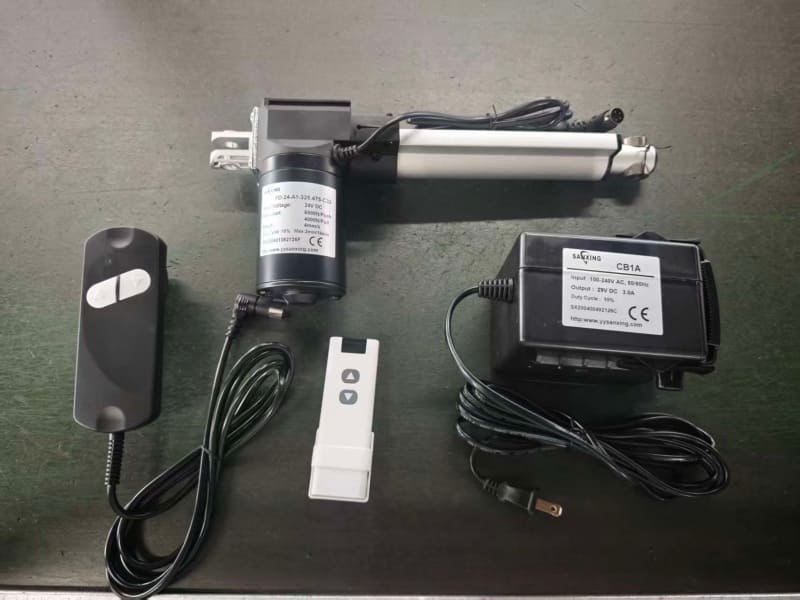
What is a scissor lift table and where does linear actuator work?
Scissor lift tables adopt stacked cross scissor arms. One end of the scissor arm is fixed on the base frame, and the other end slides on the platform bottom. As the linear actuator pushes the sliding joint, the scissor arms open, lifting the whole platform vertically. When the actuator retracts, the scissor arms fold and the platform descends.
Linear Actuator For Scissor Lift is mounted between the base frame and scissor arm joint. The actuator pushes horizontally or at a small included angle to drive the scissors. Unlike vertical pushing applications, the force required changes continuously throughout the whole lifting stroke. The highest load appears at the very beginning of lifting, when the scissor arms are nearly flat. As the platform rises and scissor arms stand up, the required pushing force gradually drops. This variable load feature is the key point when selecting Linear Actuator For Scissor Lift.
Scissor lift tables powered by linear actuators are widely used in workshop adjustable workbenches, assembly line lifting stations, low-height cargo lifting platforms, medical height-adjustable tables and agricultural lifting equipment. Compared with hydraulic systems, electric linear actuator solutions have compact structure, easy installation, clean operation and lower long-term maintenance cost. For small and medium sized scissor lift tables, electric Linear Actuator For Scissor Lift has become the mainstream option in recent years.
Why electric linear actuator becomes preferred power source for scissor lift
Hydraulic scissor lifts dominate heavy industrial lifting for decades, but hydraulic systems have obvious drawbacks for medium and small scissor tables. Hydraulic cylinder systems need oil tanks, oil pipes, sealing components and hydraulic power units. Oil leakage is a common headache, contaminating workshop floor and products. The whole system is bulky and difficult to integrate into compact scissor table frames.
Electric Linear Actuator For Scissor Lift uses built-in motor, lead screw and limit switches. The whole unit is pre-assembled. Manufacturers only need to fix the actuator on the scissor frame and connect DC power and control unit. No fluid, no pipe layout, no periodic oil replacement. The noise level is controlled under 48dB for FD1 series, much quieter than hydraulic pumps.
Besides easy installation, electric Linear Actuator For Scissor Lift supports precise position control. With optional hall sensor feedback, the system can read real-time actuator position, and realize synchronous control for dual or multi-actuator scissor platforms. This function is critical for large scissor tables to keep the platform horizontal during lifting and avoid tilting.
Core challenges when selecting linear actuator for scissor lift applications
The number one challenge for Linear Actuator For Scissor Lift selection is the variable load from scissor arm leverage. Many designers calculate only the total platform weight plus workpiece weight, then pick an actuator with matching thrust. This method will lead to underpowered lifting. At the start of lifting, the mechanical leverage ratio is at maximum, the pushing force required can be multiple times higher than the static payload.
Second challenge: speed vs thrust trade-off. Many customers hope to get faster lifting speed while keeping higher payload. Actuator speed and load capacity are inverse related for same motor and screw structure. A common wrong practice is selecting an actuator with lower thrust rating just to pursue faster no-load speed. In scissor lift projects, this choice often results in motor stall, weak lifting at low platform height, and early motor burnout.
Third challenge: duty cycle. Scissor lift tables do not run continuously. But frequent lifting cycles will heat up the actuator motor. Linear Actuator For Scissor Lift must match the proper duty cycle rating. Our FD1 series has 10% duty cycle, which fits most intermittent scissor lift working scenarios.
Key Selection Principles of Linear Actuator For Scissor Lift
When our technical team reviews scissor lift project inquiries, we always remind customers of the special force characteristics of scissor arm mechanism. Linear Actuator For Scissor Lift must reserve enough thrust margin for the peak force at the initial lifting stage. We have summed up practical selection rules from hundreds of scissor lift actuator projects.
The hidden force characteristic of scissor lift mechanism
The force required for Linear Actuator For Scissor Lift changes along the whole stroke. When the platform is fully lowered, scissor arms lay almost flat. The force arm of the scissor structure is very short, so the actuator needs much higher pushing force to start lifting. After the platform rises to 30%~40% of total stroke, scissor arms stand upright, and the required pushing force reduces greatly.
This means the actuator must withstand the peak force at the starting point. If the actuator rated thrust is only equal to the static load of the platform, it will stall when starting to lift, even though it can lift the load easily when the platform is already raised. This is the most frequent issue encountered by scissor lift manufacturers using Linear Actuator For Scissor Lift.
Why we do NOT recommend reducing load rating for higher speed
Customers often ask us if they can pick a lower thrust model for faster speed. Our standard suggestion is: for scissor lift applications, do NOT reduce actuator load rating just to get higher speed. Even if the no-load speed data looks attractive, once the scissor table starts lifting, the peak resistance will overload the small-thrust actuator. The motor will work under heavy overload state, generate excessive heat, lose torque and eventually fail.
Linear Actuator For Scissor Lift works under variable peak load. Speed is secondary for most scissor lifting table projects. Stable lifting and enough thrust margin are higher priority. If the lifting speed is too slow after choosing proper heavy-duty actuator, we can discuss adjusting screw pitch or voltage after confirming thrust safety, instead of downgrading thrust rating.
Recommended thrust rating: 6000N vs 8000N for different scissor lift sizes
For most scissor lift table projects, if the client does not have strict high-speed requirement, our default recommendation is 8000N FD1 Linear Actuator For Scissor Lift. 8000N model provides sufficient thrust margin to handle the peak force at the start of lifting, avoid motor stall and extend service life.
For small size scissor lift tables with light total payload, 6000N FD1 linear actuator can be adopted. But customers must carry out mechanical calculation on the scissor arm leverage ratio, verify the peak force, and reserve safety margin. We do not suggest using 3000N or lower thrust actuator for scissor lift structure, unless it is ultra-small miniature lifting platform with very low payload.
Common customer failure: insufficient thrust instead of poor actuator quality
A large share of after-sales tickets about Linear Actuator For Scissor Lift are not product quality defects. Customers install the actuator and find the table cannot lift load at the lowest position. They assume the actuator motor is weak or damaged. After remote technical checking, we find that the selected actuator rated thrust cannot cover the peak force generated by scissor arm leverage.
The scissor arm mechanism amplifies load at the initial lifting phase. The actual force on Linear Actuator For Scissor Lift is not equal to the weight placed on the platform. This mechanical principle is easy to ignore by mechanical designers who are new to electric actuator scissor lift solutions. Correct thrust calculation and proper margin reservation can avoid this kind of problem completely.
Sanxing FD1 Linear Actuator Specs for Scissor Lift
Sanxing FD1 heavy duty linear actuator is our mature product for scissor lift tables and other heavy lifting equipment. FD1 series supports multiple thrust grades, customizable stroke length, optional hall sensor position feedback and synchronization function. This makes FD1 suitable for single-actuator small scissor tables and dual-actuator large synchronized lifting platforms.
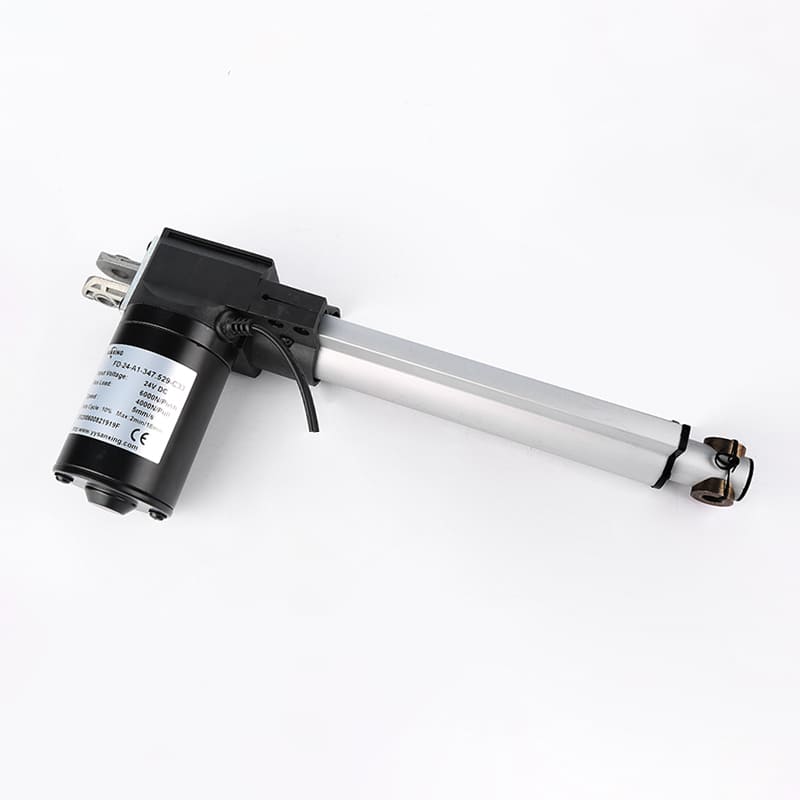
Full technical parameter table of FD1 linear actuator
| Item | Parameter |
|---|---|
| Input Voltage | 12VDC / 24VDC |
| Max Push Load | 8000N / 6000N /3000N /2000N /1500N /1000N /800N /300N |
| Max Pull Load | 6000N /4000N /2000N /1500N /1000N /800N /600N /200N |
| No Load Speed | 4 /4 /8 /12 /16 /18 /30 /35 mm/s |
| Full Load Speed | 2.2 /2.5 /4.5 /7 /10 /11 /19 /22 mm/s |
| Stroke Length | 26mm ~1000mm, customizable |
| Min Installation Distance | Stroke +150mm |
| Operating Temperature | -20℃ ~ +40℃ |
| Duty Cycle | 10%, stop 18 mins after continuous 2 mins working |
| Limit Switch | Built-in |
| Noise Level | ≤48dB |
| Material | Aluminum Alloy, Plastic, Zink Alloy, Iron |
| IP Degree | IP44 |
| Optional Feature | Hall Sensor, Synchronization |
FD1 linear actuator adopts aluminum alloy housing, sturdy structure, built-in limit switch to stop movement automatically when reaching stroke end. IP44 protection level can resist dust and splash water for indoor workshop environment. For scissor lift working in outdoor or heavy water splash condition, we can discuss higher IP rating options separately.
Working environment and duty cycle requirements for scissor lift
Linear Actuator For Scissor Lift needs to match the working cycle of the lifting table. FD1’s 10% duty cycle means the actuator can run continuously for maximum 2 minutes, then must rest for 18 minutes to cool down. This fits most intermittent operation scissor lift tables, such as workshop workbenches that lift a few times per hour.
If your scissor lift table needs frequent continuous lifting, we need to upgrade the actuator motor structure and adjust duty cycle accordingly. Operating temperature range of FD1 is -20℃ ~ +40℃, suitable for most factory indoor environment. For low-temperature cold storage applications, special grease modification can be provided.
Control System Matching for Scissor Lift Linear Actuator
Linear Actuator For Scissor Lift cannot work alone. Complete lifting system includes actuator, power supply and control unit. Most of our scissor lift customers match FD1 actuator with CB1A controller and HE wired handset, some customers upgrade to H13 wireless remote control for convenient operation.
CB1A controller + HE wired handset basic setup
CB1A control box is our dedicated linear actuator controller for single or dual actuator system. It supports 24VDC power input, can drive one to three actuators. HE wired handset has up / down physical buttons. Operators control the scissor lift table lifting and lowering directly by pressing buttons. The wired handset can be mounted on the scissor table frame or fixed on workshop wall.
This basic combination is the most popular solution for scissor lift table manufacturers. It is stable, cost-effective and easy to integrate into scissor lift equipment. The controller has built-in over-current protection. When Linear Actuator For Scissor Lift meets obstacle or overload, the power cuts off automatically to protect motor and mechanical structure.
Upgrade option: H13 wireless remote control kit
For customers who want remote operation, we supply H13 wireless remote control as an optional upgrade. Operators can stand away from the scissor lift table and control lifting and lowering without wired cable restriction. Wireless remote is convenient for loading and unloading heavy goods on the scissor platform.
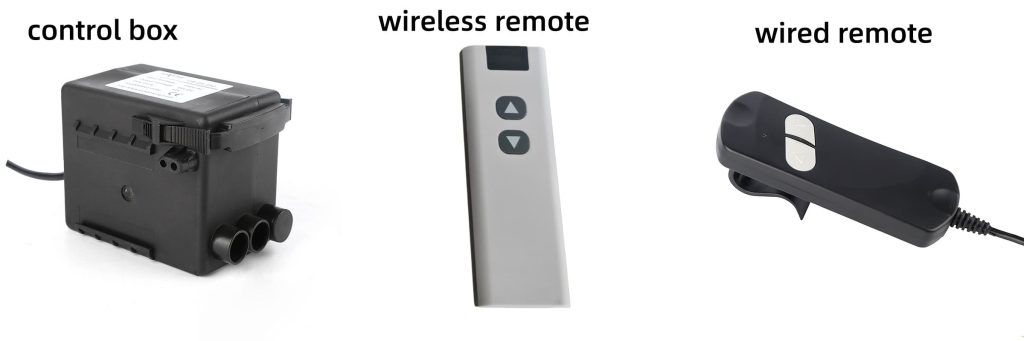
The wireless remote can work together with CB1A controller. Users can switch between wired handset and wireless remote control according to working scenario. This flexible control combination is popular for aftermarket upgrade of finished scissor lift tables.
Wiring and safety protection suggestions for lifting equipment
When installing Linear Actuator For Scissor Lift and control system, we recommend adding external emergency stop button on the scissor table frame. Emergency stop is a necessary safety component for industrial lifting equipment. Reference OSHA lifting equipment safety guidelines for safety design standard of material handling lifting tables.
The power supply should select stable DC power adapter matched with actuator voltage. Do not use unstable power source, voltage fluctuation may affect actuator output thrust and service life. All wiring terminals need insulation treatment to prevent short circuit caused by vibration during scissor table movement.
Comparison of Linear Actuator For Scissor Lift & Hydraulic Cylinder
Many scissor lift manufacturers are choosing between electric Linear Actuator For Scissor Lift and traditional hydraulic cylinder. Each solution has its suitable application scenarios.
Maintenance difference
Hydraulic cylinder scissor lift needs regular maintenance: oil inspection, oil replacement, seal ring replacement. Oil leakage is unavoidable after long time operation. Electric Linear Actuator For Scissor Lift has sealed integrated structure. No oil, no periodic fluid maintenance. Only visual inspection of mounting bracket and screw connection is required. Maintenance workload is much lower.
Installation & noise comparison
Hydraulic solution needs to arrange oil tank, hydraulic pump and oil pipes. The whole system takes large space and complicated layout. Linear Actuator For Scissor Lift is a standalone unit, easy to install on scissor arm joint. FD1 actuator noise ≤48dB, far quieter than hydraulic pump running noise. It is suitable for workshop, laboratory and medical environment with noise requirement.
Cost and precision performance
For small and medium scissor lift tables, electric Linear Actuator For Scissor Lift has lower total system cost than hydraulic solution. Hydraulic system is more cost advantage for ultra-heavy load over 10 tons. Electric actuator with hall sensor can achieve precise position feedback, hydraulic cylinder position control needs extra external sensor.
Typical Application Cases of Linear Actuator For Scissor Lift
Small workbench scissor lift (6000N FD1)
One of our European clients produces adjustable workshop workbench scissor lift. The total platform payload is under 350kg. After mechanical leverage calculation, we recommend 6000N FD1 Linear Actuator For Scissor Lift. The table is used for assembly workshop, intermittent lifting operation. The system matches CB1A controller + HE wired handset. The project finished prototype testing and moved to batch production.
Heavy-duty industrial lifting table (8000N FD1)
An automation equipment manufacturer in Turkey develops heavy-duty scissor lift table for cargo loading. The peak force calculation shows high starting load. We directly recommend 8000N FD1 Linear Actuator For Scissor Lift. The 8000N thrust reserves enough safety margin for peak force at low platform position. This project adopts single actuator setup, stable lifting performance after long time running test.
FAQ
Q1: What linear actuator is best for scissor lift table?
A: Sanxing FD1 heavy-duty linear actuator is recommended for scissor lift table. For most projects without strict speed requirement, select 8000N model. Small light scissor lift can adopt 6000N FD1 Linear Actuator For Scissor Lift. You need to calculate peak force from scissor arm leverage.
Q2: Why my linear actuator cannot lift load at low scissor platform position?
A: This is usually caused by insufficient thrust rating. When scissor arms are folded flat, the leverage amplifies resistance sharply. The force on Linear Actuator For Scissor Lift is much larger than static payload on platform. Choose actuator with enough thrust margin instead of matching static weight only.
Q3: Can I use lower thrust actuator to get faster lifting speed for scissor lift?
A: Not recommended. Lower thrust actuator will stall under peak starting load. Speed is secondary for scissor lift application. Stable lifting performance is priority. If you need faster speed, we can adjust screw pitch while keeping enough thrust rating.
Q4: What control accessories match FD1 linear actuator for scissor lift?
A: The standard matching set is CB1A controller plus HE wired handset. You can upgrade to H13 wireless remote control if wireless operation is needed.
Q5: Can I order one set of sample to test first?
A: Of course, sample orders are accepted.
Get Custom Quote for Your Scissor Lift Project
If you are designing scissor lift tables and looking for reliable Linear Actuator For Scissor Lift, send us your project data including platform dimension, maximum payload, required lifting stroke and working environment. Our engineering team will help you calculate peak force, recommend proper FD1 model and matching control kit. We can provide technical datasheet, drawing and sample support for your prototype test. Submit your RFQ now to get customized solution and factory direct quotation from Sanxing linear actuator manufacturer.
