
Image Source: pexels
A linear actuator is a tool that moves things in a straight line. You can see these helpful devices in many places. They are in car seats and hospital beds. Here are some industries where you might find them:
| Industry |
|---|
| Automotive |
| Steel |
| Construction |
| Medical/Healthcare |
| IT/Semiconductor |
| Agriculture |
| Chemical |
| Others |
You use linear actuators every day, even if you do not notice!
Key Takeaways
- Linear actuators help move things in a straight line. They are important in many devices we use every day, like hospital beds and desks that can move up and down.
- There are different kinds of linear actuators. Some are electric, some are hydraulic, and some are pneumatic. Each type is used for different jobs, depending on how much force or speed you need.
- When picking a linear actuator, think about how far it needs to move. Also, check how much weight it must lift and where it will be used. This helps it work its best.
- It is important to check and take care of linear actuators often. This keeps them working well and helps stop accidents from happening.
- Knowing what your project needs helps you pick the right actuator. This makes sure your work is done well and quickly.
How linear actuators work

Image Source: unsplash
Motion in a straight line
A linear actuator helps things move back and forth in a straight path. This straight movement makes these devices very helpful. You can see them in places like hospital beds that go up and down. Solar panels use them to tilt and follow the sun.
Here are some examples of straight-line motion:
- Manufacturing lines use linear actuators to move tools or parts.
- Hospital beds and lifts use them for safe, smooth moves.
- Solar tracking systems tilt panels for better sunlight.
- Farm machines use them to plant seeds or control water.
- Aerospace systems use them to move satellite dishes or other parts.
Tip: If you see something moving smoothly in a straight line, a linear actuator is probably making it happen!
Rotary to linear movement
A linear actuator works by changing spinning motion into straight movement. Most types have a motor that spins. But you need that spin to push or pull something in a line. Special parts help with this job.
The main parts include:
- Motor: Makes things spin.
- Gearbox: Slows the spin and makes it stronger.
- Lead screw or ball screw: Turns the spin into a push or pull.
- Drive nut: Moves along the screw for straight motion.
- Housing: Holds all the parts and keeps them safe.
- Limit switches: Stop the movement at the right spots.
- Feedback sensors: Show where the moving part is (sometimes included).
Here is a table showing how these parts work together:
| Component | Function |
|---|---|
| Electric motor | Gives rotary power (often 12V, 24V, or 36V DC). |
| Gearbox | Slows motor speed and adds force. |
| Lead or ball screw | Changes rotary motion to straight motion. |
| Drive nut | Moves on the screw to extend or pull back the actuator. |
| Housing | Protects inside parts and helps with mounting. |
| Limit switches | Stops the actuator at full extension or retraction. |
| Feedback sensors | Shows position information (optional). |
The lead screw works like a ramp. When the motor spins the screw, the nut moves along the threads. This pushes or pulls the rod in a straight line. Ball screws use ball bearings to make movement smoother and handle heavier loads.
Here are some common ways to change spinning motion to straight movement:
- Lead-screw driven: Uses a threaded shaft and nut.
- Ball-screw driven: Adds ball bearings for less friction and more strength.
- Belt driven: Uses a toothed belt for longer distances.
- Cam systems: Uses a special wheel shape for straight movement.
Many industries use this trick to change spinning to straight movement. You can find it in manufacturing, medical equipment, cars, airplanes, construction, home automation, and farming.
Note: The main idea is always the same—turn spinning motion into straight movement—no matter where you see a linear actuator.
Linear actuator types
There are a few main kinds of linear actuators. Each kind works in its own way. Each one is good for different jobs. Here are the most common types you might see.
Electric actuators
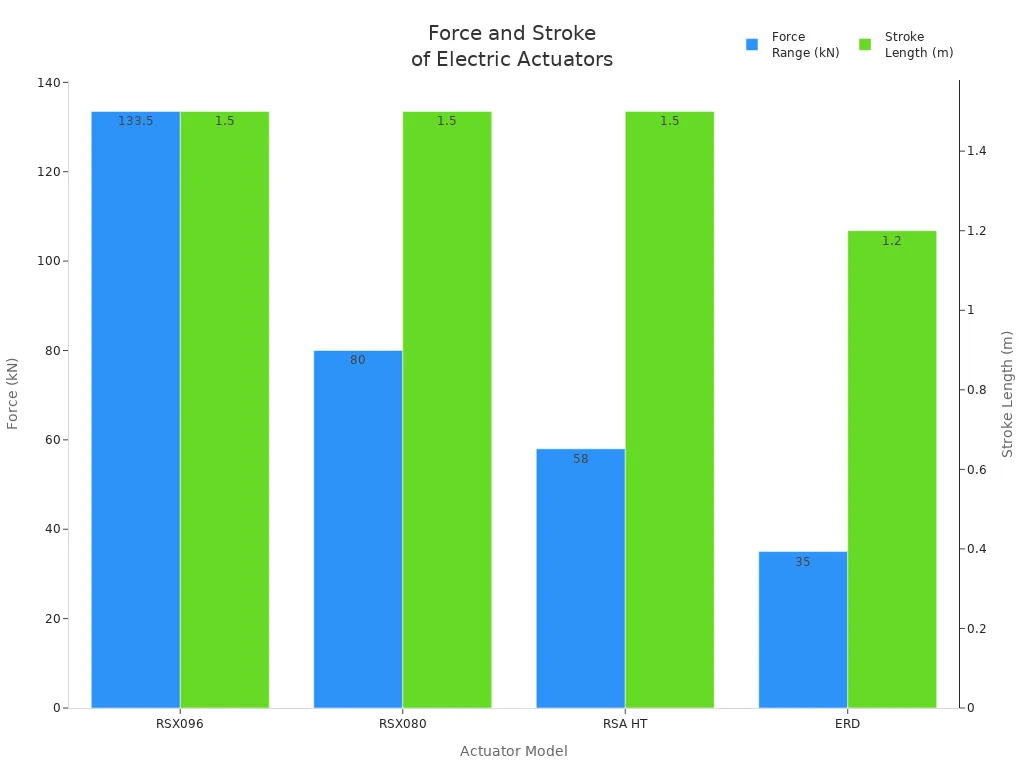
Electric actuators use a motor to move things in a straight line. You can find them in homes, robots, and factories. These actuators are very accurate and easy to control. They are great when you need smooth and exact movement.
| Actuator Model | Force Range (kN) | Stroke Length (m) |
|---|---|---|
| RSX096 | Up to 133.5 | Up to 1.5 |
| RSX080 | Up to 80 | Up to 1.5 |
| RSA HT | Up to 58 | Up to 1.5 |
| ERD | Up to 35 | Up to 1.2 |
Tip: Electric actuators are good when you want quiet and clean movement.
Hydraulic actuators
Hydraulic actuators use oil under pressure to move heavy things. You see them in big machines and construction tools. These actuators can push or lift with lots of force. For example, a 3-inch hydraulic cylinder at 2200 psi can make about 15,000 pounds of force.
| Advantages | Disadvantages |
|---|---|
| High force capabilities | Needs lots of care |
| Simple design | Not very efficient |
| Strong build | Takes up lots of space |
| Low cost | Sensitive to temperature |
Note: Hydraulic actuators are best for jobs that need lots of power, but they can be messy and need regular care.
Pneumatic actuators
Pneumatic actuators use air that is squeezed to make things move. You see them in factories and medical machines. These actuators move fast and work well for light or medium jobs.
- Air pushes a piston inside a tube.
- You can change the speed and direction by changing the air flow.
- Double-acting types move both ways for better control.
Common uses include:
- Moving things on assembly lines
- Opening and closing valves
- Controlling air in HVAC systems
Mechanical actuators
Mechanical actuators use gears, screws, or belts to move things in a straight line. You might see them in kitchen racks or solar panel trackers. These actuators are very accurate and can repeat the same movement.
| Feature | Linear Actuators | Rotary Actuators |
|---|---|---|
| Motion Type | Straight line motion | Rotational motion |
| Precision | High | Moderate |
| Applications | CNC, medical, solar | Robotic arms, conveyors |
Example: A spice rack that comes up from your counter uses a mechanical actuator.
Piezoelectric and micro actuators
Piezoelectric actuators use special stuff that changes shape when you add electricity. These actuators move tiny amounts with very high accuracy. You find them in science tools and high-tech machines.
- They react right away to electric signals.
- They can make strong force for their small size.
- They are best for jobs that need tiny, exact moves.
| Characteristic | Description |
|---|---|
| Stroke | Small, but very exact |
| Force | Strong for their size |
| Reaction Time | Instant |
| Applications | Science tools, micro-positioning systems |
Piezoelectric actuators help scientists move things just a little bit!
Each kind of linear actuator has its own good points. You can pick the right one based on how much force you need, how far you want to move, and how exact you want the movement to be.
Linear actuator applications

Image Source: unsplash
Home and daily life
You can find linear actuators in many homes. These devices make life easier and more comfortable. Here are some ways people use them:
- Windows and shutters can open or close by themselves for safety.
- Ventilation systems change air flow to keep rooms fresh.
- Beds and recliners move the head or foot rests for comfort.
- Kitchen cupboards and pantry doors can open with a simple touch.
In the last ten years, more homes started using linear actuators. The market for electric linear actuators is growing very quickly. Experts think it will be worth over 41 billion dollars by 2035. This means more people want smart homes with things that work automatically.
Tip: If you use a desk that goes up and down or an adjustable bed, you are already using linear actuator technology!
Industrial and commercial uses
Factories, farms, and hospitals use linear actuators every day. These devices help move, lift, tilt, or pull heavy or delicate things. You can find them in many different industries:
- Food and drink factories use them for safe and fast movement.
- Big building windows and doors can open or close by themselves.
- Cars use them to move and open different parts.
- Factories and machines use them to move things exactly where needed.
- Construction machines, like cranes and diggers, use them for careful movement.
- Farms use them for planting and watering with more control.
- Robots need them to move arms and parts in the right way.
- Hospital beds and surgery tables use them for smooth changes in position.
- Airplanes and defense systems use them for landing gear and guiding parts.
Note: In factories and other workplaces, you must check and care for these devices often. Regular checks help machines work well and stop accidents from happening.
Choosing a linear actuator
Key factors (force, speed, stroke)
When you pick a linear actuator, you need to think about a few important things. These choices help you get the best results for your project.
- Stroke length: This is how far the actuator moves. Make sure the stroke fits your space and the job you want to do.
- Force and speed: You must know how much force you need to move your load. If you want more force, you may get less speed. Faster actuators usually give less force. You cannot maximize both at the same time.
- Load and moments: Check where the load sits and how it moves. If you ignore this, you might damage the actuator.
- Precision: Some jobs need very exact movement. Decide how accurate you need the actuator to be.
- Duty cycle: Think about how often you will use the actuator. Heavy use may need a stronger model.
Tip: Always check if the actuator can fit in your space when fully extended and retracted.
Environment and safety
The place where you use your actuator matters a lot. High temperatures can break down lubricants and cause more wear. Humidity can make metal parts rust if the actuator is not sealed well. Dust can get inside and wear out moving parts.
Here is a table of safety features to look for:
| Safety Feature | Why It Matters |
|---|---|
| Design Suitability | Handles the right pressure and temperature |
| Easy Maintenance | Lets you check and fix the actuator safely |
| Good Lighting | Helps you see what you are doing |
| Proper Operation | Prevents mistakes that can break the system |
| Right Tools | Makes sure you use the correct parts and tools |
| Protective Gear | Keeps you safe during work |
| Careful Handling | Prevents damage during moving and setup |
| Thermal Protection | Keeps the actuator working in cold places |
Note: Always follow safety steps and use the right gear when working with actuators.
Matching type to need
You should match the actuator type to your job. Start by listing what you want the actuator to do. Think about the weight you need to move, how fast you want it to go, and how far it should travel. Write down your goals and put them in order of importance.
- Figure out your load and how much it weighs.
- Decide how fast and how far you want to move it.
- Think about the place where you will use the actuator.
- Check if your team can install and care for the actuator.
- Pick the actuator that fits your needs and budget.
Avoid common mistakes like picking an actuator that is too big or too small. Always test your setup before using it for real work.
You now know that linear actuators make things move in a straight line. They turn spinning motion into push or pull movement. You can use them to lift, slide, or adjust objects with ease.
- They work with different energy sources like electricity, air, or oil.
- You should check the load, speed, and environment before choosing one.
Electric actuators are easy to install and save space. Use these tips to pick the right actuator for your next project. Keep learning and enjoy making things move!
FAQ
What does a linear actuator do?
You use a linear actuator to move objects in a straight line. It helps you lift, push, or pull things with smooth and controlled motion. You see it in many machines at home and work.
Where can you find linear actuators in daily life?
You find linear actuators in adjustable beds, sit-stand desks, automatic windows, and kitchen cabinets. Many smart home devices use them to make your life easier and more comfortable.
How do you choose the right linear actuator?
You look at how much weight you need to move, how far you want it to travel, and how fast you need it to go. You also check the space and environment where you plan to use it.
Are linear actuators safe to use?
You stay safe by following instructions and using protective gear. You check the actuator often for wear or damage. You make sure the device fits your needs and works in your environment.
Can you fix a broken linear actuator yourself?
You can fix simple problems like loose wires or stuck parts. For bigger issues, you ask a professional for help. Always turn off power before you start any repairs.
Linear actuators are pivotal in various applications, facilitating movement in a straight line for both residential and industrial purposes. Their versatility extends to adjustable furniture, automated window systems, and kitchen mechanisms, enhancing convenience and efficiency. When selecting a linear actuator, it is essential to evaluate the load capacity, travel distance, speed requirements, and the operating environment to ensure optimal performance. Adhering to safety protocols and regularly inspecting the actuator for potential issues further guarantees reliable operation.